Episode Transcript
[00:00:00] Speaker A: Welcome to Thriving.
Thriving is created by the Discipleship and Advocacy team of the Synod of Victoria and Tasmania Uniting Church in Australia.
This podcast is produced on the unceded land of the Wurundjeri people.
[00:00:16] Speaker B: Hi. Lovely to be with you, Sandy.
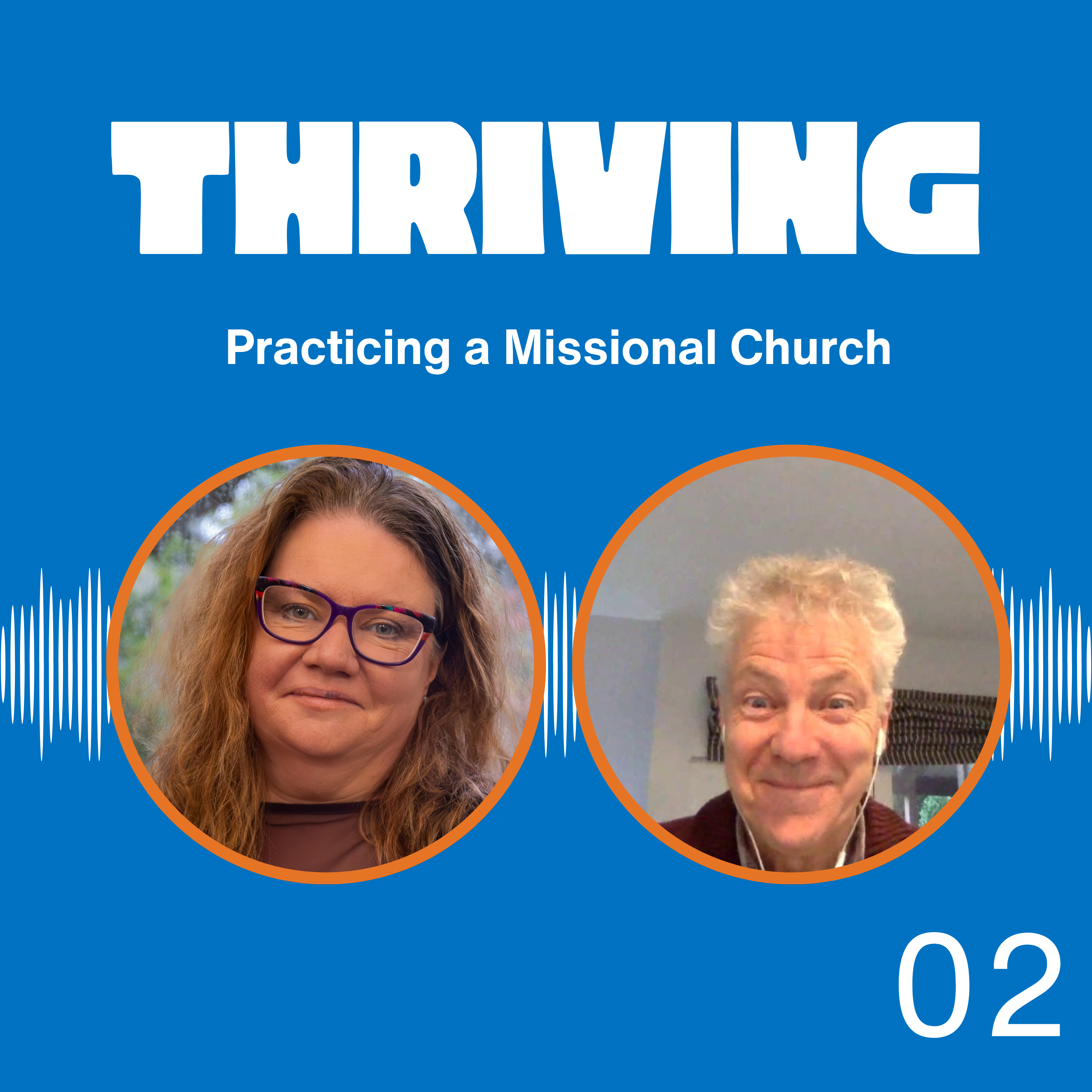
[00:00:18] Speaker A: First time I met Dave, he was in Melbourne doing some work about how to grow communities of faith, fresh expressions of church. And that was right at the beginning of my work in the Banyul Network. So Dave is a person who I've really appreciated all along being able to talk to and being able to learn from in person.
But he also writes good books and you can find him in other places as well. So, Dave, tell us a little bit about you and how did that all happen for you?
[00:00:48] Speaker B: Yeah, well, I had a passion for people that didn't go to church. And when I was in the north of England, I realized that the church wasn't really geared up to connecting with people outside the church. I plant a new church which we called the Net Church, which was really aimed at people who didn't go to church at all. And this was before Fresh Expression. So this is back 1997. I was one of the first to be involved in what then was called Fresh Expression. So there was this big report in 2004 called Mission Shaped Church Reports, which came to Australia as well, was a bit of a game changer. And it was the Church of England saying, not we need to do this, but this is beginning to bubble up in lots of places and how do we respond to this as a church? And actually what we were doing in Huddersfield was the first church that was kind of the story was given on Page Six. And so because of that, people kept contacting us and coming to see us. And then I ended up training people to start these kind of churches. So none of it was planned.
Like the whole of my life, it's all been slightly accidental, trusting that God somehow is in it. And. Yeah, and Australia again was. I met two guys who came across from Adelaide, were looking for someone to talk to. We had a very nice breakfast. I thought that was the end of it, but I enjoyed my free breakfast. And then the next thing is they were asking me to come across to do training on Fresh Expressions and new church communities. And I mean, I've had the pleasure and honor of, I think it's 11 visits now across to Australia.
So I'm loving coming across. Apart from the cricket, which I know I said I wouldn't mention, but apart from that, loving being in Australia and getting to know people like you and all over Australia.
[00:02:29] Speaker A: So you've, you've done lots of training and the Fresh expressions movement has changed a lot in the last. What are we up to now? 15 years or so. What are the things that you've learned about how to grow a successful new worshiping community? Whether you want to call it a church plant or a fresh expression, what would they be?
[00:02:48] Speaker B: Yeah, well, first of all, Sam, just say so. This has been going on for 30 years now across here in England, so that's worth just noting. I think that this isn't a short term thing and I know when I first came across to Australia there was a sense of, oh, we've tried this for a year and it hasn't worked. And I think that's one of the big things that we've learned. This takes time. Yes, I think the key thing is God. I know that's the obvious answer, but I think prayer and discernment is at the heart of what this is about. There's very much a sense with new worship, worshipping communities, new Christian communities, fresh expressions, whatever you want to call them, of, well, where is God at work and how do we work where God is at work with him? So it's not just, oh, this is the latest thing, let's try it. There is very much a sense of, okay, let's pray and discern where God's at work and what can we do.
I think the other thing that we're learning and have learned from early days is that worship isn't probably the best starting place that we live in a post Christian culture. So having a kind of Sunday service worship culture is good at connecting with people who've got church contacts, but not so good for the majority of our populations that are way outside. And that it starts as always with relationships. That that is the key. I always say that the three key things are love, create and relate. So it is about loving people because we're first loved by God. It's about beginning to say, how then does that love send me out? How am I building up relationships, not just the leaders, but all those who are involved and how are we working where God's at work in those relationships? And then lastly asking that question, well, what could we do to help these people not only relate to us, but begin to relate to Jesus as well. And I think those are the three simple, clear things. And I think as I look back on my ministry often we did it the other way round. We created something. So we started, let's have an all age service and then we're Saying, right, you now need to relate to people who've got children and young people. And then they start coming and we think, oh, they don't kind of quite fit in, but we're meant to love them. And so we reverse that order, which. Which isn't a way of working.
[00:05:08] Speaker A: So how do you.
How do you get the Jesus content in there? I was in a conversation with some people earlier today who were thinking about these ideas and a couple of people were saying, we're, we're talking to people that are interested in sort of spirituality, that are interested in gathering together, but really don't want to talk about faith stuff and really don't want to talk about religion. Whereas you're suggest accepting that the Jesus stuff is actually pretty core and important.
[00:05:34] Speaker B: Yes, I think it's absolutely core. And we've done some evaluations recently on where things are working well. And actually one of the things that comes out of that is actually being averse about our faith. And I would always say the best way to start that, and this is what we did in Huddersfield, is to say that we're part of a church. I think one of the dangers in all this is that we pretend we're something else and then suddenly we switch everything and say, oh, by the way, there's this Jes Jesus thing in it. Whereas saying this is part of a church thing and that. That just sets the kind of tone for the whole thing.
And I think the other thing, certainly here, and I think in Australia as well, is that there is a greater openness to not just spiritual things, but things around Christian faith than there probably has before. And I think often the church is very nervous about talking about Jesus. But my experience now, particularly with younger people, is actually they're very happy to talk about Jes Jesus. And my worry sometimes, and I. I know this from my own experience, is that. That actually people from outside the church are quite nervous if we don't talk about Jesus because they're like, well, what's happening here? Because that is your thing. It's not. It's not being embarrassed about it, but obviously recognizing the context and how we talk about it is important as well. But I think it is. It's very much about just being ourselves. And I think one of my phrases is we can only express what we experience. So I think there is something about our own discipleship and spiritual life which begins to overflow and which people both see by our actions but also hear by our words as well.
[00:07:16] Speaker A: I remember one time when I was in the UK visiting You. And we were sitting in a coffee shop somewhere or other, chatting, and I was telling you about what I was doing in my previous placement and the new congregation, the new worshiping community, we were growing and mainly people who'd been very badly disaffected by church. And me saying to you, oh, it's not really a fresh expression, Dave, it's really a bit more like church. Like it's actually about Jesus. And you, you looked me in the eye and said, well, the, the clues in the name, Sandy, they're called fresh expressions of church. And I went, oh, it was kind of like a light bulb moment for me that, oh, actually that's what I meant to be. What I'm actually doing is what I meant to be doing. And I felt really freed up because I had been a bit kind of unsure about how to talk about it in the Australian context. But being told, well, Sandy, it's actually about church, I found incredibly helpful. And that's probably, probably seven, eight, nine years ago that you said that to me, but I still carry that around in my head.
[00:08:14] Speaker B: Yeah. And I think that is important because we often talk about fresh expressions. But actually, as I said to you then, you know, the full name is Fresh Expressions of Church and it comes from a phrase in the Church of England's ordination service about freshly expressing the gospel in every generation.
And I think that is the key. How are we freshly expressing the good news about Jesus for the context in which we find ourselves? And when we do that, what happens is that a community begins to form. I think we plant the seeds of the good news of Jesus and then begin to see how a community grows from that.
[00:08:53] Speaker A: So fresh expressions and particularly are not fussed about the form that they may take on, are they? What sorts of things have they looked like in the uk?
[00:09:04] Speaker B: I think the form kind of comes from the community that it's part of. So you'll have everything from what will look like very traditional church because you're trying to connect with people from older generations. We're seeing more and more things out in, like, Forest Church and that kind of thing which are saying, you know, people want to connect with nature, so let's do that out there. I know of a online church that is happening, but they also meet monthly to walk into the countryside and find kind of spiritual areas where people have been worshiping God in the past. So a whole host of different forms, things that happen in sports clubs, things that happen in pubs, but as I said, also, you know, things that would look more traditional thinking about who are the people that we're. We're trying to connect with and how do we create something that will enable them to connect with Jesus?
[00:09:59] Speaker A: Tell me, Dave, what kind of leadership is necessary to grow these types of community? I mean, you're an ordained Anglican priest, I'm an ordained Uniting Church minister. Are the people that start these things often people like us, or are they more often people less like us?
[00:10:16] Speaker B: Yeah, I think they're often less like us. So I just. To plug. I wrote the book how to pioneer, even if you haven't got a clue, really, for. For ordinary people. I wanted to call it Fresh Expressions for Idiots, but they wouldn't let me use that title. But it was very much saying, actually, anyone can do this. I think if you've got a heart for people who are outside the church, then I think you can do this. And probably at least half of the Fresh Expressions in the UK are led by lay people, and most of those have had very little training. But it is about just the ability to, as I said, pray, discern and begin to gather people around you and see what happens. So, no, I think that a lot of people can do this. It's not that difficult. I worry, particularly when I see books about this, which are really thick and very complicated diagrams. I see this happening all the time. So I'll give you one good illustration that I often use. A group of mums who have got children at primary school. They were praying for the school and then they felt God saying, we need to. You actually need to do something. So they asked the school if on a Friday, after everyone had dropped off their children at school, whether they could have a classroom and just invite people to come along and have something to drink and eat, but also to offer prayer. And they, through that community, began to talk more and more about Jesus. I got a phone call from my friend sue and she said to me, I've got a real problem, Dave. And I was thinking, oh, no, what's happened? And she said, I've got a horrible feeling I've started a church. And basically that's what they had done.
Had very little training, but actually, because they'd gone down this, you know, we love the people we're meeting on at the school gate. How might we relate to them at the school gate? And then what could we create? Actually, they'd done it. And, you know, we've done some research in the Church of England the last two years, and over one and a half thousand new Christian communities, starting through the local parish church, the local church and When I ask bishops, how's that happen, they all say to me, got no idea. Cause it is just local people recognizing where God's at work and saying, let's try this and see what happens. And of course, a lot of those, or some of those at least, will not work. And that's part of the whole thing. You take that risk. There's no guarantee but trusting God that He is at work in and through this.
[00:12:44] Speaker A: So are there ways that denominational churches can help and support, or is it better for them just to get out of the way and let the Spirit do what the Spirit's doing?
[00:12:53] Speaker B: No, I think there is a role for the denominational church and the church at a kind of regional level very much. I mean, now we have the three priorities for the Church of England. One of them is mixed ecology, which is that mixture of fresh expressions and church plants and traditional church as the norm. So I think that sets a really good framework for what is happening. And it's about as well about resourcing both people and finances and time.
So I think at that level, they can't do lots of stuff, but they can set the right environment for that to happen. I think that can be key. And certainly our research shows that if the kind of denomination at national, regional level is clear about this priority, then that really does make a difference. That kind of clarity of saying, this is about what we're about and this is real church and we want to support and encourage you and we're going to provide training and all those kind of things is really important. But in the end, it is a think about local people, in a sense, being moved by God and responding and doing stuff and doing that, loving and relating and creating.
[00:14:07] Speaker A: So could you explain what. Once upon a time we used to call this mixed economy, and now we've gone to this ecological language, which I find really helpful. What is mixed ecology? Why and how do we help that to thrive in the church? Maybe an example, if you've got one.
[00:14:25] Speaker B: Yeah, no, great question.
Yeah, yeah. So I think, I mean by mixed ecology, we mean that mix of traditional churches, we've already known it, or inherited church, as it's called, fresh expressions, new communities, missional communities, church plants, all those things. But I think with mixed ecology, it's the importance that they're not mixed in that sense of kind of separate bits in a pot. But actually they all need each other. If you look back at church history, there's always been a mixed ecology. You see it back in the Book of Acts, you've got this Jewish church and then the Gentile church grows up. It's the first fresh expression and that causes some problems, but actually, in the end, they learn to live with each other and support each other. So in the mixed ecology, it is recognizing that diversity of experience of church, but all are valid church and all need each other. So the newer learns from the more traditional, the more traditional gains energy from the newer. And so it's interesting that when we look at our priority of mixed ecology, at the heart of that is what we call parish churches, but local churches revitalized for mission, because we recognize that at the heart of this is the local church recognizing we're not connecting with the whole of our community and we might need to do something new to connect with certain parts of that. So there is this strong correlation between how the local church is seeing mission and the thriving then of what we call fresh expressions or new Christian communities. So I was going to say it'd be a church that will have maybe have a traditional service on a Sunday, it may have a messy church on a Tuesday, it might have a sports church on a Friday.
And so that and recognizing and supporting and encouraging all those parts of it. And that happens at a regional level as well.
So for me, that's the kind of mixed ecology. And as you said, we used to use a phrase of economy, mixed economy, but I think the ecology is a much better word because so much in ecology is about that you're not just having one crop, you're growing, but actually the interrelationship between the soil and the crops and the land is really important.
[00:16:42] Speaker A: Another thing that someone I was talking to today was talking about was the problem of the traditional church or the inherited church expecting to tell new things how they should be. And you know, where the experience one, and you know, this is what you must be like. And also, and I know in messy church have this conversation all the time, the expectation that sooner or later people in these new things will grow up and start coming to real church. So, you know, one day all their bums will be on the seats in traditional church.
What's the answer in the mixed ecology for that sort of thing, for the things thriving alongside each other, perhaps?
[00:17:20] Speaker B: Yeah, I mean, I think that is very true. It is recognizing that these new things are as valid church as the inherited. They're not a kind of station on the way to proper church.
They are proper church. Just in the same way that, you know, if a church has a 8am service and an 11am service, those two different congregations, they're both true congregations.
And so I think it is about recognizing this is not on the way to being the church on a Sunday at 11. This is about recognizing there are a number of ways in our context to be church. And so we're doing that. But actually each of those bits needs each other. They're not just independent congregations.
We are really working together. And I think that's where the leadership bit comes in as well. That the key leaders in that church are explaining to people why we need all these bits together and they're all vital to the mission of the church in our particular community.
[00:18:27] Speaker A: What are the gifts and graces we're looking for in leaders or amongst leadership in these kinds of communities or, you know, the skill sets. If we were to use corporate language, what are we looking for? What are we discerning about?
[00:18:40] Speaker B: That's quite a hard question. It is so individual. And I think one of the dangers with this is, you know, we think about extroverts, you know, over the top leader, that kind of thing, picture of that, that kind of person. And I see a whole mixture of people who are fresh expressions leaders. I think one of the major gifts is humbleness. So it's that recognition of actually I haven't got all the answers and therefore I need to depend on God in that. And part of that is that prayerfulness in that. I think the other thing is courage. I think you really do need sometimes courage in this. A to try it and B to keep going when it doesn't always work the way you thought it might work. And some of the best leaders I've seen in this have the courage to actually try it and to keep going with it when sometimes it's not always easy either because of criticism or because what they're trying taking longer to do.
And I think the third thing is people who are really good at relating with those outside the church. I think that's the other key thing that's really important in this. So people who often are kind of on the edge of stuff and have that kind of relationship with people outside the church is really important. So I would say those are the probably three key gifts and graces that leaders need.
[00:20:00] Speaker A: Yeah, that sounds wonderful. And if you were to give the Uniting Church or people in the Uniting Church any advice about what they should do if they were thinking about starting something new, what would that advice be?
[00:20:11] Speaker B: Always nervous about giving anyone advice. I mean, I think, I think my simple advice is the thing with this is actually give it a go. What you do might not be where you finish up, but actually give it a go. Maybe try something for three months, see if that works, adapt it, change it, have another go for three months. And yeah, and just see prayerfully where God is at work in that. But I think the art of the start, as I often say, is key. I see two dangers. One is people starting too quickly, but I see the other major danger is people taking forever to get going and never really starting something. So they're always having conversations and committee meetings about what they could do.
And I think sometimes the best way to learn is to give it a go and see what happens. And I think part of that is just sharing God's heart. For those who are outside the church, how does God feel about those people and how do we respond to that? That is really, really important.
[00:21:14] Speaker A: I often talk about play. It's good to play with these things and I think that fits with your idea of, you know, trying something for three months and then being prepared to shift it so you don't actually have to alight on the perfect methodology or exactly what's going to work and spend six months, 12 months, three years planning that before you start. You just start. People will let you know or they'll say, actually, you know, if you did it this way or what if we try that and if you have a very genuinely open and hey, we're just, we're all working this out, we're all playing, we're all having a go, then that, that permission giving, I think, and that humility perhaps is also there. Allows people, other people who are, who are not part of the, you know, whatever is the organising group, to actually offer themselves or offer an idea or try to have a go as well. So I think, you know, no one cares if you make a mistake when you're playing. And I think all too often church councils and church bodies want everything signed up, lots of, you know, documents written beforehan and lots of. I mean, certainly it's important to do the safeguarding and church safe stuff first, but you don't have to make every decision about how this is gonna work before you get onto it. Would that be what you'd say?
[00:22:22] Speaker B: Absolutely, yeah. Yeah. So I often quote James Dyson of the, you know, the Dyson Cleaner. I think he had 735 prototypes before he got to the Dyson that we have today. And I think, oh, I'd got to. I'd have got to about three. And then I thought, this is never gonna work. And I like the language of prototypes.
One of my heroes, George Lings, uses that language that when you're working with a prototype, you know, it's not necessarily going to be that what it looks like at the end, but it's part of how you get there. And I think that frees people to say, as you said, language of play or prototype or whatever to say, this is about finding out, this is your discernment, you know, And I think that's a really key thing that we often talk about the beginning of the process, about discerning. But actually discernment is there throughout the process. And I know when we started the church in Huddersfield, we changed so much over the seven years that I was leading it because we just realized certain things weren't working. We need to change them, and that's okay. And part of the problem is that we have obviously our model so often of traditional churches. It's been like this for a hundred years or whatever, but actually, even that traditional church has changed from a hundred years ago. And it's part of that thing, as I said, a fresh expression expressing the good news of Jesus in every generation.
It does change. And let's go with that and release ourselves from that sense of this has got to work first time. And I've had bishops ring me up saying they want to start this. Can you guarantee me it will work? And my simple answer is, I can't guarantee you that at all.
We'll see what God is up to.
[00:24:05] Speaker A: Yes. So I guess the encouragement for us to try new things and to have a go and to.
To do that, which is part of the Australian culture and has been for a long time.
[00:24:15] Speaker B: Danny, at the end of each chapter there's. It kind of assumes that there's a small group who are working through it. And at the end of each chapter there's a question or a number of questions to help you think about starting something new. So it's very practical and it kind of looks through the stages of how to start something and as I said, gives you questions and ideas and that kind of thing. So. So it's a really good resource which you can order through Church House Publishing as well. But if you went through this with three or four of you in a church, it would really help you to get something going and to be kind of have the right principles and ideas and thoughts as you begin that.
[00:24:54] Speaker A: Fantastic. Well, thank you for that and we'll look forward to the next time we manage to get you out to Australia and hopefully down to Melbourne to spend some time with our new communities as they're getting things off the ground. And it's always an encouraging thing to have a conversation with you, Dave. So thanks very much.
[00:25:11] Speaker B: No, as always, great to talk, Sandy. And yeah, and I will be praying for the Uniting Church and for all of you as you continue the great work you're doing.
[00:25:21] Speaker A: Thanks, Dave. Bye for now.
[00:25:23] Speaker B: Bye.
[00:25:25] Speaker A: Thank you for listening to Thriving.
This podcast is hosted and produced by Sandy Prudine. If you have have enjoyed Thriving, don't forget to like and subscribe. You might also like to share with your church community or friends and talk about how these ideas can help you grow your thriving community of faith. We'll see you next time.