Episode Transcript
[00:00:00] Speaker A: Welcome to Thriving.
Thriving is created by the discipleship and advocacy team of the Synod of Victoria and Tasmania Uniting Church in Australia.
This podcast is produced on the unceded land of the Wurundjeri people.
Hello, everybody and welcome to the Thriving podcast. It's great to have you with us today.
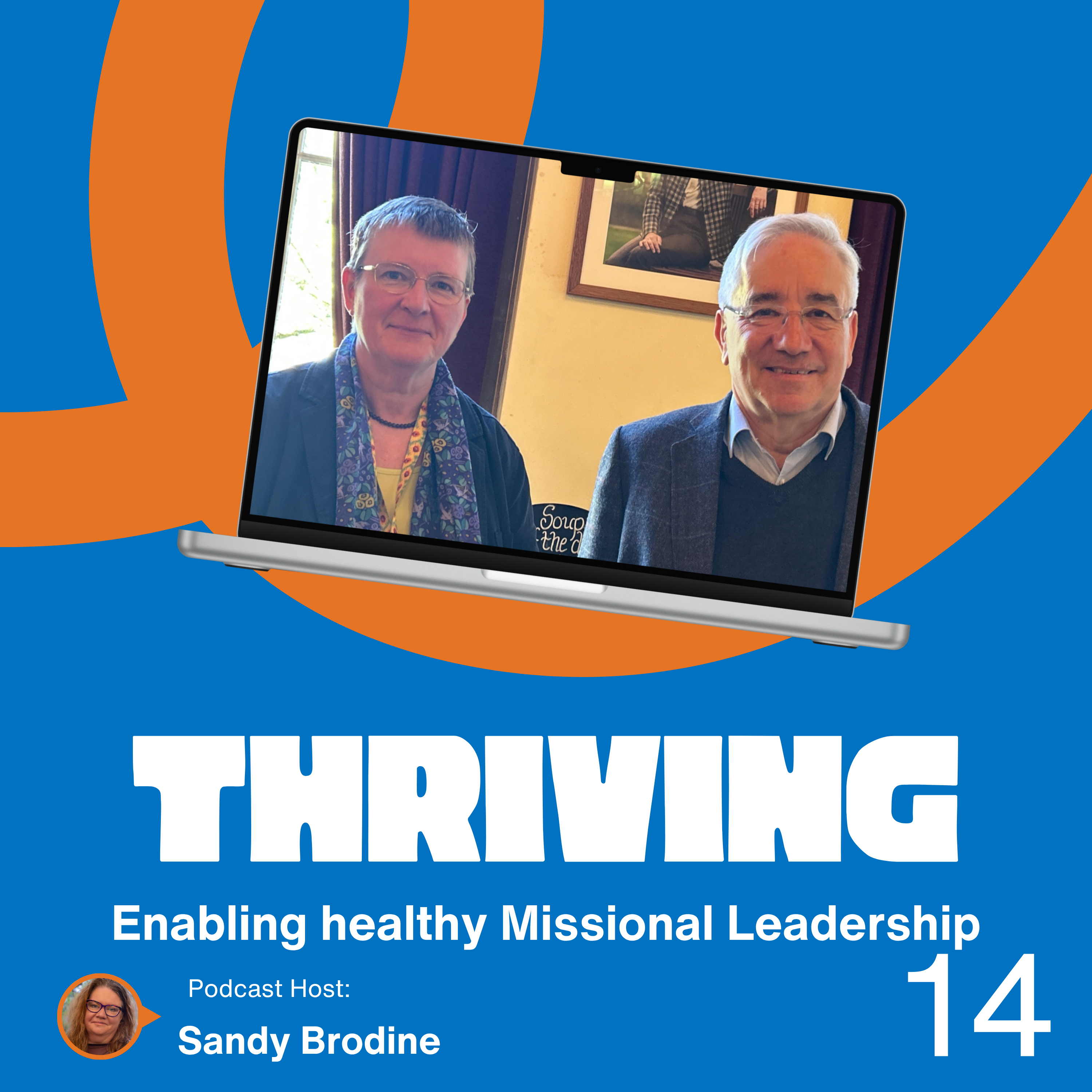
Today I'm joined again by Steve Taylor, who is my colleague from New Zealand who I am going to be teaching, practicing a missional church. And we're to start in July. And one of the things that we're wanting to do as part of this is to think about change management and think about how church polity and the way we make decision in churches is important and how we can best grow thriving communities given the way our churches work. And so I've invited my friend Helen Cameron from the UK to join us tonight. Hi, Helen. And Helen is going to introduce herself to you in a moment. But I met Helen last year as part of a subject I did with Wesley House in Cambridge University around enabling skills and growing skills to work with churches. So I got to read Helen's work during that course and got to know Helen and she's an extremely helpful person to know. So we're going to pick Helen's brains about growing thriving communities. Yeah.
[00:01:20] Speaker B: Hi, Sandy and Steve. It's great to be online with you and to have an opportunity to share with the people you're teaching and your listeners. So you're right, Sandy. We know each other through the Methodist College in Cambridge, which is called Wesley House, where I lead a course called Enabling Skills for Ministry and Mission. And that's a course which equips people who are responsible for ministry or mission to work with people rather than for them or direct them. So it's helping people achieve their own ends. And so as an important part of my own approach and philosophy and something I really enjoy teaching, that's a sort of a side hustle. My day job is working for the Baptist College in Oxford. Yes, Oxford and Cambridge do sometimes meet in the same person.
Regent's Park College is the Baptist College which is part of Oxford University. And I'm their Director of research, which means I oversee the research going on in the college, encourage more of it, and line manage the early career researchers in the college, which is a great delight. But my academic interests really focus around practical theology. So how do we do theology in a way that makes a difference to people in the life of the church and the world, and then also congregational studies. So how do we understand what's happening in the local church and how do we align that with God's will for God's people?
So those are my two key areas of academic interest.
[00:02:44] Speaker A: So when I did this subject last year that Helen was teaching, I started reading her work, a book called Resourcing Mission Practical Theology for Churches. And as I started to read this book, Helen, I know you're in the Baptist Church and the Methodist Church in the uk, and I'm in the Uniting Church in Australia and Steve's in Zealand. I could see and imagine all of the people you were talking about in real lived examples that I know in the Uniting Church as you explored the scenarios and thought, oh yes, I know those people. Oh yes, I know that situation. So that was one of the things I enjoyed most about your book, was just how frighteningly real it was to me, but also how sensible your suggestions were. Helen, tell us something about the styles of church that you outline in the book. You have five different styles of church.
Just give us a quick outline of what they are and how they differ from one another. And some of these would be missional communities, wouldn't they, rather than traditional Sunday morning church.
[00:03:45] Speaker B: Yeah. So what I try to do in the book is think about how the local church fits into culture. And we, we live in an age where people are constantly picking up on cultural cues and cultural signals as a way of constructing their identity and showing what they align with and what they don't align with.
And sometimes we're a bit naive in the church and think that somehow we're not sending off cultural cues and that people aren't reading us in the cultural way as well as in a religious way. So although I'm very interested in what you've called polity, which is the different church traditions we belong to and how they understand governance and decision making. And we may come back to that later because I think theologically that's important. I start the book by suggesting that there are five forms of church which are sending out different cultural cues to people in society, some of which are more easy to read than others. So if we're thinking about this well established forms of church here in the uk, the parish would be one of those forms. And that's part of the Church of England and the Roman Catholic Church and the Church of Scotland, which are two of those who are established churches in the uk. And so they have a geographical area and they'll engage with anybody who sits within that geographical area.
And that gives off a kind of cultural cue of like a utility. So here's something that I can plug into that Provides me with something I need and it's available in my area and it's available to everybody in my area. And I argue that actually the idea of a public utility where you, you play a, pay a flat fee and everybody gets the same service has collapsed in the UK because most of our utilities are privatized.
And so people shop around to get the best deal. And so that doesn't really fit with what a parish is. So there's some interesting things about that as a cultural form. I then talk the congregation churches which are associational, which have members, which who worship together to give a foretaste of God's kingdom. And again that sends out cultural cues about people getting together around a common enthusiasm, a common passion. And that's a form which certainly in the UK has really, really shaken over recent decades and that people no longer want to join things, they want a transaction rather than to join. So for us in the uk, even things like guides and scouts, which are, you know, internationally known, are really difficult to sustain because they involve signing up, showing up, paying up and getting stuck in. And that combination of things, whether it's in, in scouting or in the church, just, just doesn't seem to send off the right cultural cues. So what I do then is move on and think about three newer forms of church which are sending off slightly different cultural cues. And I start by talking about the small group church where church is largely organized around meetings of small groups. And the cultural analogy I'm add there is with, with book hugely popular in the uk, both face to face and online, where people just get together for their own purposes in a small group, usually with like minded people and support each other and exchange views. And so I can see the kind of cultural cues that that is sending off for people. Then I also talk about third place church and this is an idea from an American sociologist, Ray Oldberg, who said that people now want a third place they can go to which isn't home and isn't work, but it's somewhere where they can show up and just hang out with people. And that kind of hanging out space in the UK is almost entirely provided by coffee shops where you can show up, you rearrange the furniture, you talk about what you want to talk about and then you push off and you don't have to worry about the washing up and you don't have to worry about what time it's going to close. And that's the kind of vibe which these kind of churches are trying to offer people sending out that sort of cue that you're here for the conversation, you're not here to make the thing happen. And a lot of church life is about how are we going to make things happen.
And then the final form that I've, I speak about in the book is what I've called magnet church. That isn't a technical term, but whenever I use it, people go, oh yes, I know which one that is. And it's about churches which deliberately set them up to attract parents and families and they recognize the challenges of parenting as a Christian in a very confusing and, you know, culturally complex world where there's all sorts of stuff online, all sorts of stuff happening in schools. And so you're trying to create this community of shared community of parenting, and often employ paid youth workers, paid children's workers, to offer something really professional and well thought through. And that often acts as a magnet, sucking families out of other churches locally, but enabling this particular way of being church to thrive. So I'm not saying that's a definitive list, but I'm wanting to contrast more traditional ways of being a parish or congregation with perhaps more contemporary innovations in terms of third place church, small group church, and magnet church.
[00:08:37] Speaker A: So just to say that one of the things that's important to understand about Australia is we're disestablished. The entire religious landscape in Australia is disestablished so that the Anglican Church doesn't have the role that it does in the UK and that, that was set up right from the, from the time that people, white people arrived in Australia, church people arrived on those very first boats because the Catholics and the Reformed Protestants who were non Anglicans, didn't want it to be that way. And so we probably have the four, really, we have congregation and certainly in the uniting church congregation, and then the, you know, the multiple possible options about new ways of doing things. Steve, how's this sitting with you?
[00:09:21] Speaker C: It makes a whole lot of sense. I do wonder whether in Australia and New Zealand we still do have the parish in the sense of church is imagining that they're taking responsibility for everyone in a set area. Yeah. So I'll be interested in, in whether Helen wants to, to respond in terms of the, the sociology of how that parish model operates.
[00:09:41] Speaker B: Yeah, it's one of the things which is interesting is that some of the diaspora churches from Africa that have come to the UK over the last 20 years have set up a parish system because they see themselves as being responsible for all their fellow co religionists within a particular area. And so the first thing they do is divide the country into parishes and have brought that way of thinking with them, which is very interesting. So I, I think so I think the Church of England, this is not true for the Church of Scotland and the Roman Catholic Church. For them it's very important to differentiate between this available to everybody within a certain set of boundaries and their perceptions of congregations, which are often that their member benefit rather than public benefit. Now most people, non conformists, me included, would disagree heartily with that. But nonetheless that's the perception that they see themselves as there for everyone, irrespective of their faith or no faith.
[00:10:38] Speaker A: So one of the other things you talk about is leadership styles and how power and authority work in different types of churches. I wonder if you could say something about how power and authority work in the more attractional, missional forms of church that you've spoken about. How does power and authority work? And how when you've got one of those existing in a mixed ecology setting, how does that power and authority perhaps rub up against things like presbyteries and synods or more established forms of decision making? That's not too complicated. As a question, I'll give it a go.
[00:11:14] Speaker B: I guess one of the things which is interesting about the word leadership is that it doesn't really appear in any of the historic Christian polities. It's not a way of thinking about ministry. And so I would say that the use of leadership language is in itself a cultural evolution that aligns more with the way in which people talk about what's happening in business or public sector schools, hospitals, and even the voluntary sector. And so that leadership language is an importing of a secular understanding of how people come together and why they do things. And so sometimes can sit uneasily with understandings of ministry that are present in our, in our church politics. I think the more attractional forms of church that I've spoken about often mimic something which is either quite top down or quite bottom up. And it depends. It's only when you're through the door that you sort of realize which of those that you're, you're dealing with. So I think because some of these are initiated by very entrepreneurial people, often perhaps from a more middle class background, where they've had a familiarity with secular workplaces which are more pyramid organized, where there are clear leaders and clear followers, then they feel quite comfortable with a senior pastor or a, a lead person who, who has overall oversight and then delegates things to people accordingly. That can often sit quite unhappily with more traditional polities, particularly if you're in A congregational policy where decisions are made by a congregation or by an elected group from a congregation, and where there's a much more collegial sense of decision making and leadership. And this more directive form of leadership can seem not not religious or not not Christian in some quite profound way to people, way they can't quite put their finger on. I think some of this willingness to have a more managerial style in these more attractional forms of church links to people's overriding desire to get on with the doing and spend less time on the making the doing happen. Over your used so earlier I used the example of a cafe where I walk in and I don't really have to think about whether there's enough milk in the fridge, whether the fridge is at the right temperature to satisfy the environmental health people, who's going to do the washing up, what time we close. All of that is taken off me. I walk through the door, I pay something which is clearly more than the cup of coffee costs to make. But in paying for that, I'm paying for the freedom to arrange the furniture, to have the conversations. I want to come and go as I please to make that happen behind the scenes. That's seeming informality requires a lot of organizing behind the scenes. And so often there are paid people behind the scenes who are making it happen, creating that space and making sure that it's compliant and ready to receive people. So I think that's a compromise which a lot of people are willing to make in order to do something which is more which releases people from organizing the thing as well as taking part in the thing. And of course this can be very difficult for people who've grown up in a strongly congregational polity and tradition to accept because part of the certainly in non conformity, part of the freedom which you are exercising is the freedom to associate and to organize for your purposes, or as you would see it, in the church for God's purposes. So it the organizing is part of what you're the way in which you're expressing your religious commitment belong to a form of church where all that is taken off your shoulders and all you do is the showing up in the participating somehow seems to be.
I've often heard the phrase lacking in commitment only turning up when it suits them, only paying for what they get. And so those kind of phrases are signals that something is deeply grating against a more traditional and received understanding of church, which people are probably deriving from a particular denominational polity.
[00:15:02] Speaker A: Many, I mean many churches do have somebody who has gone through some sort of religious formation program and may have been ordained with an authority to preach, for example, or to be able to be the one who stands at the front and does the Bible engagement, talking people through what, you know, how they understand the Word and what the Word might be speaking to them today. So we do have, I agree that it's not formal kind of business type leadership language, but we certainly have power and authority given to a particular person.
And I think where that can be tricky in non conformist churches such as the Uniting Church is when you have the person who has that role and nevertheless they're not somebody who has decision making power.
So that's kind of how the polity works in the organized church.
And yet if you come in wanting to have that authority, running a new community, all the signals are very, can be very different and very confusing I think, can't they, for lay people coming in wanting to lead a new community?
[00:16:03] Speaker B: Yes. And obviously each I. My feeling is that many non conformist denominations have become what I would call quite clericalized. So because the amount of activism that lay people can offer has been diminished for all sorts of reasons to do with the restructuring of family life, the restructuring of the labour market. Then often clergy whose role is word and sacrament and pastoral care have been forced into a quasi managerial role. And the relationship between ministers and lay people which is expected in the polity has become frayed and they've had to take on a more managerial role. And this is often where the language of leadership has crept in because it's been a desire to cast clergy in the role of leaders. For some that's been a happy landing. And they can combine at the skills of word, sacrament and pastoral care with the skills of organizational leadership. For others, there's a feeling that this is an uneasy mix for them. And so in these situations where you've got innovation sitting alongside traditional forms of church, I think a good way to open up a respectful conversation is to say what is it in our polity that we want to cherish and value? What is, what are the ideas about God that underlie that? So for example, in a traditional polity where there's a combination, yes, of an ordained minister, pastor who's been trained and hopefully has some skill in words, sacraments and pastoral care, that often been a role for, for lay people in helping the church be organized, undertaking various activities in the church, secretary, treasurer, elder, whatever type, you know, all sorts of titles like that. And that's been done in balance. It's been a partnership between the ordained and the lay, rather than the minister directing the lay people. So it's being done as a partnership. And so, so the wisdom, I think, about God, and particularly about the Spirit which is embedded in that, is that God both calls and gifts individuals and enables them to be set aside in order to speak God's word to God's people. But also for a community to discern the way forward, it's important that there's a group who are praying together, listening together and seeking together what the will of God is for their time and their place. And so I think it can be helpful if newer, perhaps more managerial leadership ways of doing things can just pause and hear some of that wisdom from the Christian tradition which says, yes, God is with us, but often discerning God's direction for us isn't straightforward. And we need to do that as a group of people as well as by listening to key individuals. And so I think some of the tension between what perhaps can be seen perceived as managerialism, which is a word for saying management has run amok versus traditional, which means you're so stuck in, in your committees, nothing's ever going to happen. Some of that tension can be diffused by just thinking what is the theological wisdom that underpins this. And I sense in the newer forms of church, there's a huge energy for mission. There's a sense of urgency, don't you know, there's whole generations of children growing up without any meaningful knowledge of the Christian gospel. Let's stop meeting in committees. Let's just get on and do something about it. So some of that sense of urgency comes through the, the, the more missional and attractional form of church, whereas more traditional forms of church, I think, are more rooted in a history of, of the Christian tradition which says we need to find ways of listening to God which are mutual and which take on board both the, the voices of those who have a special calling to ministry and those who are part of the body of Christ.
So, yeah, I think it's, it's never going to be whenever the word mixed appears, you know, it's not going to be easy. And we know in most ecologies, you know, there's a danger of setting up a food chain where some things are waiting to consume others. And if we're to have an ecology which is peaceable and equitable, then I think it's necessary to listen perhaps to the missional urgency of newer forms of church, but then also listen to the understanding of discernment of God through the Spirit that's going on in some of the more traditional forms.
[00:20:00] Speaker C: Steve, I was extremely helpful to listen and grateful for your wisdom. I was thinking about what it would mean if someone wants to be involved, a leader, a person coming out of our courses wants to be explore some of these newer forms, small groups, third place magnet church. But they're being placed into congregations that have those more historic ways. And any wisdom you have on how a person might navigate that, do they have to give up all their newer form dreams or, or can they actually manage and navigate through some of those mixed economy models?
[00:20:37] Speaker B: I, I don't think it's straightforward is it? And I don't think you can prescribe for any one context what's going to work. There are some. On the course previous year of the, the course that I was talking about earlier, we had somebody who was in exactly that situation.
They had been placed into a church which was traditional but had decided that because of its shrinking numbers it was open to new things. And so she, she brought some new things and that tested their openness.
And so she came under course saying they said they were open but then when open means change, then that could throw up all sorts of things for people. And I guess what she went away from the course with was a desire to listen attentively those tensions were. And to understand what people might feel they were losing as well as potentially what they might be gaining. I guess one of the things in church life is that it's so easy to dismiss the detail. The gut feeling that something isn't right. The clumsy way of expressing I'm not enjoying this. I, I don't like this. Without trying to then dig and dig and dig and say well, what's, what's, what's at stake here? What is it that you feel you, you're losing and helping people think about that.
[00:21:46] Speaker C: That.
[00:21:47] Speaker B: Yeah, that, that trade off between things that they may be having to set aside and things that they might, might be gaining. And that's a patient task because I think it's, it is perfectly possible to just swerve past existing forms of church. Find yourself a coffee shop, book a session, get going. And for some people that's the right way to innovate. For other people there is a desire to innovate out of the historic church. And so then there needs to be. Time needs to be given for that patient listening. And some, something of what people feel they're losing is often this cherished sense of cooperating together to make something happen and somebody showing up and saying it looks like this, it needs to be done like this. And I need you to be supportive, but I don't necessarily need you to make it happen. That can be quite a hard thing to hear. If part of your cherished self understanding of a Christian is that I, as part of the body of Christ, I have a responsibility to make the church happen rather than just be a participant in, in the church. And so spending that time to be with people and getting, get to know them and what's important to them is, is hugely important. I'm actually ironic I'm talking about this because the church I belong to is, is busy making a proposal for a new mission initiative to our, our denomination. And we've only got to where we've got to out of a patient process of being with each other. And actually we've spent seven years doing things in the location that we want to move to or do something new in. And so we've had a chance to listen and learn as to, to what's happening in that, in that location. So I think being relational really important.
And then I think there's, as I say in the book, I do attach a lot of importance to not dismissing detail. And I think this can be a real tension between people of different educational backgrounds. I've, I've had a great blessing of being married for nearly 40 years to a shepherd who deals with, he's retired now, but he used to deal with very real animals and very real mess and grass and whether it was growing or not and rain on whether it was falling or not, and so deals very much in practical realities. And he was constantly reminding me that my enjoyment in abstract time ideas and dreaming up new dreams is fine, but until it's rooted in a reality, not everybody will engage with it or get it. And so I think when people raise a specific detail, and I use the example of seating arrangements in the book, as that's one that lots of churches can identify with. You can't start to ask the questions about, okay, so you've identified this as something that you're unhappy about.
Why is this important to you? What does this say to you about the kind of community we're trying to be in order to show God to people? And tracking back from what seems like a detail to people's understanding of the ministry of the church and then to their understanding of the mission of church and then to their understanding of God can be a really good way of opening people up to saying, okay, maybe I could let go of that detail, because I can see there might be some other ways of expressing what it is about ministry, mission and God that is important to me that don't rely upon this concrete detail. But I think often, because people in ministry have had an abstract training in training in theology, and they can often sound quite dismissive to details. Those women arguing about the china again, what cups were drinking out of, you know, and just dismissing it as a trivial matter, when actually for some people, the quality of the cups, just the quality of the hospitality, and they're desperate that the hospitality is seen to be respectful of people and welcoming of people and giving people an experience which they can culturally recognize because it's the kind of cup that they would be given if they went into a coffee shop. So it's those kind of unpicking and unpacking which I think is, is. Is. Is the second thing that I think is, is, is. Is really, really important. I do think it's good to be able to resource what you're doing through the Christian tradition, however you encounter that, whether it's through scripture, through texts from the tradition of your church, perhaps through hymns and songs, there may be ways in which people remind themselves of what they believe. So rooting what I think is important. And again, in the book, I tried to give some examples of how you can work with both doctrine and stories from scripture to show. To exemplify something of what, what you're trying to do. I think that's three. So I think I'll pause there, whether there's a couple of things that you would, you would mention because you've both got a lot of experience in this area as well. So you may be thinking, oh, but she hasn't said X.
[00:26:13] Speaker C: Well, I was reflecting. You used the word what are you losing?
Quite a bit earlier on, Helen, and I was thinking about how loss implies a sense of grief.
And so there's a sense of, of changes about grief work. But creating spaces for people to talk about that grief without it being, oh, therefore we won't do it. Because grief is a natural thing and talking about it can allow us to grow or change. Yeah. So having sort of spaces where the grief can be reflected upon without an agenda behind it around. If you grieve this way, we'll do this. If you grieve that way, we'll do that. Yeah. So importance of good grief work, I think, which ministers should be quite good at,
[00:26:53] Speaker A: I think too. And this is why I like the mixed ecology model that starting new things alongside traditional church rather than changing Sunday morning. So, as you know, Helen, I'm very heavily involved in messy church and there are a number of churches who think, oh, this is great, we'll do messy church on a Sunday morning. We'll just get rid of Sunday morning and do it once a month. And it never works because the people that come on Sunday morning and have been part of Sunday morning church for their whole lives, maybe 70, 80 years, come because they love that. That is what feeds them and nourishes them. So to say, oh, if we're gonna sweep away what you find meaningful, we're gonna put this other thing in, isn't gonna work. But if you do it at another time alongside, and you honor the fact that this thing that people have been coming to their whole life is actually life giving for those people, but actually we need to do something else to support other people. And we're gonna try and keep those things together. You know, we're gonna have coffee together and get to know each other and build relationship. But actually we're gonna do them separately, I think honours, because I think the fear and the. And the grief of. But this is what I love and you're taking it away or you don't think it's important can really make it much harder to start new things than is necessary. I think that will be my 2 cents worth. How does that sound, Helen?
[00:28:02] Speaker B: Yeah, no, I. I would agree with, with both of those. I think there is a.
[00:28:07] Speaker C: There's.
[00:28:08] Speaker B: There's a lot of grief in the life of the church and inevitably we focus on individual experiences of bereavement, but perhaps less on those. Those corporate experiences of loss. And interestingly, in my own CH community, I found that revisiting some of the symbols that we have has been a way of helping people feel that there is some continuity and that actually that symbolism may being read in a different way, but its potency isn't lost. And sometimes in an enthusiasm to move on from tradition, there can be a desire to abandon symbols. And so I think thinking what the symbolic language of the congregation has been and whether that can be carried forward or reinterpreted in some way is also valuable.
Yeah, I'm agreeing with both of you.
[00:28:52] Speaker A: And there is something to be said about the deep practices of the church over many centuries having a lot to offer us, but I think they get kind of layered on with so many accretions of things that we don't really understand what they're about. So part of. I think what helps what you've just said happen, Helen, is actually helping people to understand why we pray a certain way or why we sing these songs. And what is it about these things that are meaningful for us as Christians? How do they help us to follow Jesus? And if you, if you do some of that work of. Actually, there's an educative process going on here where we're helping people to understand what it's about that can help people to love things and to learn why they matter, not just, well, I come in here, I've never been here before. I come in here and why do they keep singing these songs out of this old book that, you know, I don't understand, or they have strange words or whatever?
[00:29:40] Speaker B: I think the thing I often say to people is just, I don't know what it's like in Australia, New Zealand, but in the uk, just entering any public building to do something collectively with people, people is a culturally weird thing to do.
[00:29:51] Speaker C: Y.
[00:29:52] Speaker B: Especially if you haven't bought a ticket online beforehand. So we might feel that we're some wanting to change things in order to be more culturally resonant. But even the thing we're asking people to do, which is to assemble and worship, is something which is. Doesn't have very many cultural analogies left. And so I think people kind of expect it's going to be weird because the whole proposition's a bit weird. You know, I'm going to meet together with a group of people, some of whom I might know, some of whom I. I don't know at.
Some of whom look like the kind of people I would hang out, some of whom look like the kind of people I would definitely wouldn't hang out with. And we're all going to sit still in this room for an hour and focus on something which isn't of our.
At our direction and where I can't switch channels, you know, I can't deflect onto something else.
Is, is, is, is. Is a big ask, I think, for people. And so I think however we shape it, we're asking for something, something which doesn't sit easily with people's contemporary experience. Had a lovely older woman join our church quite a while ago. Now she's in glory now. And she was completely bemused by this turning up and not going out to make a cup of tea and not changing channels kind of stuff, you know, and when we had the. What she called the commercial break for the notices partway through the service, she'd always turn to her neighbor and loudly giving them a sort of a running commentary on how she was experiencing things, sort of not. Did you have goggle boxes box?
[00:31:15] Speaker A: Yep.
[00:31:15] Speaker B: I've seen it yeah, yeah, yeah, yeah. Not quite goggle box, but sort of heading in that direction, you know. And for her that was just like a normal thing to do. If you're watching something with somebody that you're comfortable with, then of course you turn to them and give them a little lowdown on how you're experiencing it. So there's all sorts of things which if you are a long term church attender you are socialized into, which you just have got no idea that you're socialized into it. But there are all sorts of behaviors that you. Micro behaviors that you've adopted which don't sit naturally with our culture at the moment. And so I think it's just being, being open to that and just being very open to people's behavior.
[00:31:49] Speaker A: Yeah, yeah.
[00:31:51] Speaker C: I was, I was interested in whether you had. Because you talked about top down and bottom up and, and. But most of your examples then went to top down leadership. So I'm interested in how you see bottom up models of leadership working, particularly in newer church contexts. Newer forms of church.
[00:32:06] Speaker B: Yes. I haven't come across a lot of them to be honest. I'm sure they're out there. There. I mean, I guess in terms of traditional polities I would be thinking of things like Quakerism and Baptist life. And I think sometimes Baptists have spawned newer forms of church which are more bottom up. So perhaps small groups which are self directed which then perhaps come together monthly for a corporate act of worship together. But the majority of small group churches I've come across are nonetheless quite top down with some directions to small group leaders should be doing doing. But it clearly is entirely possible for them to be, for them to be bottom up. So I think certainly in the UK the Baptist denomination has a creative tension between those, those churches in membership which are avowedly bottom up will and the Bible are read with the help of the Holy Spirit in the context of the local church. End of. And those which are much more. Okay. If we want to reach out to people in mission, we need a clear leadership structure. We need a clear hierarchy and paid employees and so a much more directive working. And so the two, the two are coexisting within the one. The one.
[00:33:14] Speaker C: There are things like community development models of church and sort of World Cafe which to me are ways of trying to structure in sort of bottom up ways that are a bit more contemporary.
[00:33:27] Speaker B: Yeah, absolutely. And there are definitely churches and think perhaps we've got an example of a Vineyard church in the UK and some of the Nazarene Strand churches which are very much starting from a community development first approach approach and then seeing what builds from there.
So I would agree with you, Steve, There are traditions which are committed to that way of working.
[00:33:49] Speaker A: Helen, if I was starting a new church and I was coming into a denomination or coming trying to be alongside a denomination that I didn't know very well and I didn't understand the polity, like, when do I go to the congregation? What's a church council? How do I interact with the presbytery? What on earth is that synod doing there? How do I negotiate all of this? What would be your best advice for how to navigate coming into church governance and making sense of it from the outside?
[00:34:18] Speaker B: So I think I would see. Start by seeing your ignorance as a gift. What you don't know means that you're going to ask a whole lot of questions, which may even provoke people to think.
So I think asking questions respectfully and then making a careful note of what you're told so that you can go away and process it and think about it is important. I guess most important for me was whatever you do, don't try and do this on your own. You need somebody alongside you, ideally somebody who's offline to the situation where you can go away and process what you're learning and make sense of it.
And then you referred to the course. I mean, I think you. There was a fundamental decision to be made as to whether I see myself as an entrepreneur trying to sell something new to an existing structure, or whether I see myself trying to work both with and against the grain of an existing structure. And so my priority is the withness. And so. And so until the withness is working, I won't be branching out. Whereas for other people, the urgency and the passion and the skill to branch out is so powerful that what they're really trying to do is to negotiate with an existing set of structures, to have the space in which to innovate. So I think it can be quite helpful to work out which of those you are, because that will guide the way in which you structure the conversations with people. But I think my top two tips, as I'm learning to call them, are one, understand the value of your ignorance, and two, whatever you do, don't go it alone.
[00:35:43] Speaker A: Amen. The body of Christ has many members, right? That we're meant to be in community with others and working alongside others. I think that's a really good place to land. Certainly new communities need to. Need to have many members or at least have, you know, people working alongside each other. In team and in in in the body of Christ. Helen it's been delightful, Steve, It's I hope our students are going to enjoy this conversation and other people who might listen along on the podcast and that this might help them think about how they can grow thriving missional communities.
Can I just give a plug again to your book? Helen so that's it. Resourcing Mission Practical Theology for Changing Churches and by Helen Cameron. And my copy I got on Amazon on Kindle so you can you don't even have to get a hard copy and you certainly don't have to get it sent out from the uk. Thanks for joining Steve and I today, Helen. It's been lovely to talk to you.
[00:36:36] Speaker B: Thank you.
[00:36:36] Speaker A: Bye.
[00:36:36] Speaker B: You're welcome.
[00:36:37] Speaker C: Thanks.
[00:36:37] Speaker A: Helen Kakite thank you for listening to Thriving.
This podcast is hosted and you thank produced by Sandy Brodine. If you have enjoyed Thriving, don't forget to like and subscribe. You might also like to share with your church community or friends and talk about how these ideas can help you grow your thriving community of faith. We'll see you next time.