Episode Transcript
[00:00:00] Speaker A: Welcome to Thriving.
Thriving is created by the discipleship and advocacy team of the Synod of Victoria and Tasmania Uniting Church in Australia.
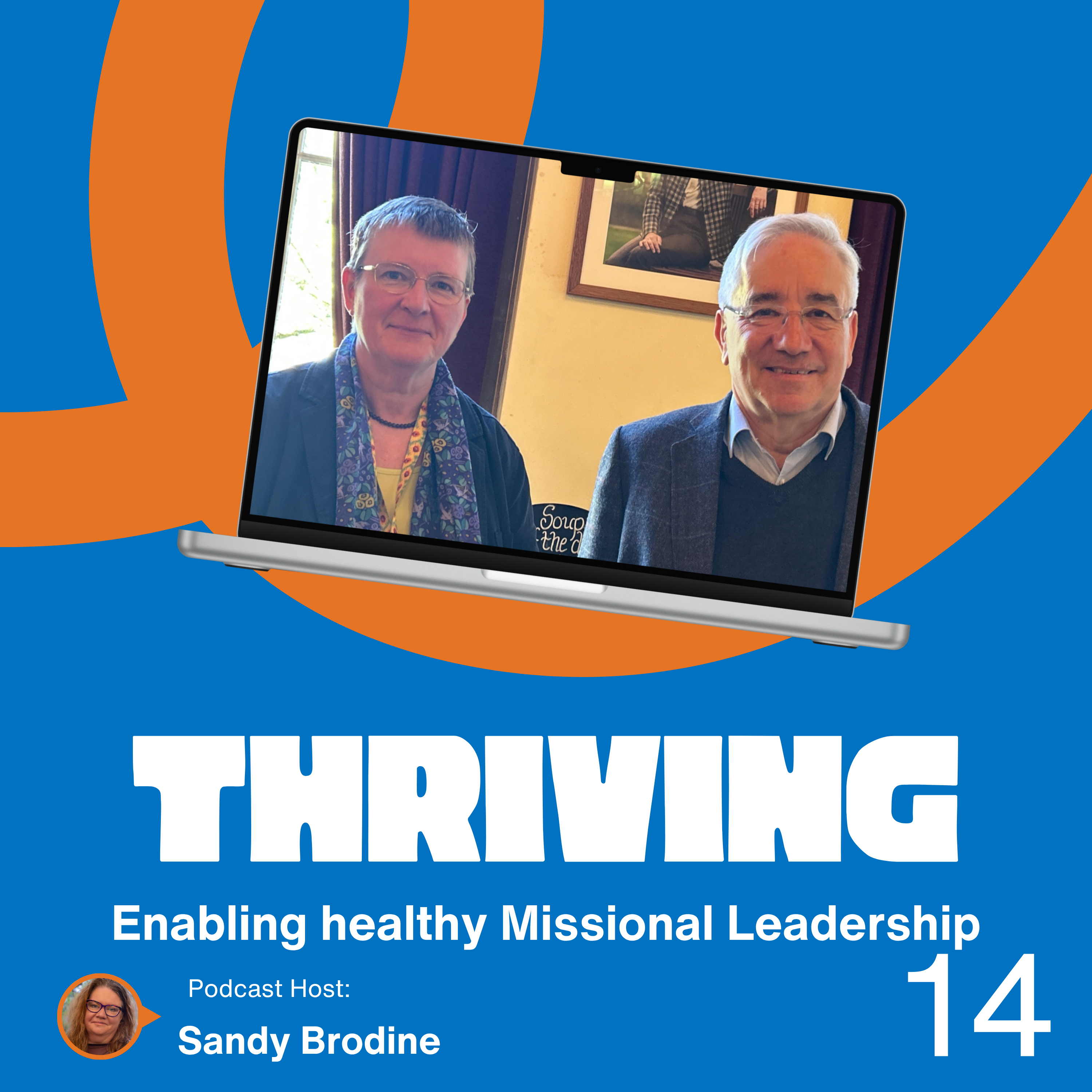
This podcast is produced on the unceded land of the Wurundjeri people. So I'm here with Helen Cameron and David Dadswell in Oxford in England, and I had the pleasure of working with David and Helen last year on an enabling course.
And so we're thinking about thriving churches and how we can grow thriving communities of faith that grow disciples and faith formation, particularly with younger people. And I guess could you tell us a bit about the enabling skills course first? Then we might think about how it might be something that would help grow thriving communities. So just tell us a bit about yourselves and the enabling skills course, please.
[00:00:52] Speaker B: Okay, well, I'll start by introducing myself. I'm Helen Cameron and at the moment I'm director of research at Regent's Park College Oxford, which is a Baptist college. I've been involved in teaching enabling skills for 25 years now, something I'm very passionate about and something which I've done alongside a number of jobs over the years. And I would describe myself as a practical theologian with a particular interest in how church organisations work, which is the strand I teach on the course and I'll come back to that later.
[00:01:23] Speaker C: I'm David Dadswell. I've. I've got quite a mixed background. I'm a Church of England priest and I worked for a couple of decades as an international management consultant, working in all sorts of commercial, industrial, public and not for profit types of organizations.
I've been teaching this enabling skills course as a person who does consultancy around and about in place for the same sort of time. As Helen said, we've been working together for quite a long time on that. And the whole idea of people being able to be supported in doing what they're doing and being helped to think clearly through it is, in a grown up sort of way, I think is really crucial.
[00:02:04] Speaker A: And he's a third teacher.
[00:02:06] Speaker B: Yes. So a third member of our team is James Butler and he leads the pioneer training at the Church Mission Society in the uk and he's been teaching alongside us for the last three years now. And he's particularly interested in the relationship between practical theology and missiology. And so he really brings a keen interest in how people reflect theologically on their work and how that links to the mission that they're engaged in.
[00:02:33] Speaker A: So what on earth is enabling and why should we do it?
[00:02:38] Speaker B: So I guess it's a word that we've tried to use to describe an activity which is different from being directly responsible for an activity or for people, but it's about coming alongside them. And the idea of being an enabler is to help either an individual or a group of people identify what their goals are and then identify a realistic way of pursuing them. And obviously, if that's within a church context, to do that within the framework of faith and belief appropriate to the setting that they're in.
So a typical transition that we would help people with is that for some people, they've been very successful as a youth worker or a children's worker, or as in local church ministry, where they've had a group of people that they're directly responsible for. But then when they move into a role where they need to come alongside others and help them do what they're supposed to be doing, as opposed to what they would think was the right thing to do, then that involves a transition to thinking about, how do I work with people in the way that enables them to come up with a good process for achieving what they're trying to achieve. So, as David's already suggested, there's a lot of emphasis on processing the course. Maybe you could say a bit more about that and then I'll come back and say a bit more about the organisational and the theological bits. Yeah.
[00:03:51] Speaker C: I think one of the big things that happens is that there is an assumption that if you have, as Helen said, done the job in a frontline sort of way, that you can then help people do the job. And I think it's what we are hoping to do through enabling skills training, is to encourage people into how to manage the process. So that helps the person as much as possible, that it's not about saying, I did this like this 15 years ago, because that might not be appropriate Now. What you can help the person with this, thinking through what they're doing, what is their purpose, where they're trying to get to, how are they analyzing, what about the people that they're working with, all those sorts of things. So we will do a lot of stuff around the mechanics of the process, in that we'll look at real situations and ask students on the course to bring situations they're involved in. So it can be quite powerful. And there are all sorts of issues about being confidential and treating this as precious, because this is people's precious stuff, the work that they're involved in. But it is very much about saying, don't get too hung up on the confidence, because actually the person you're working with in the end should Be the person who, as Helen says, takes accountability for what they're doing. You are there to help them and you've got a different role in that. But it is a collaborative work. So either you're not just a.
I'll just listen to you talking and we'll just see what happens, or I will tell you what the right answer is. It's somewhere in that difficult middle that says, let's work this through together. And I will help you think through this. I will bring some, particularly some expertise in process in how we have that conversation. Well, because sometimes people find that very difficult and sometimes need to have an understanding of actually what is their accountability.
I'm not going to be doing your job with your group of toddlers or 15 year olds or whatever. All I can do is help you think through what you're doing and take apart and put back together what you're in the middle of.
[00:06:00] Speaker A: So what I liked about it was that it was quite organic and it was about each enabler discovering what skills they could have to improve their practice. Rather than being the kind of coaching skills training that I've seen before, where there's a fairly strict set of things that you say and you repeat and you do, you know, which I find I can't do, I would prefer something that was much more organic, much more responsive to the person that you're talking to. And that's outstanding to me.
[00:06:31] Speaker B: Yeah. And I think a lot of this is about where the ownership for the action lies. And it's been clear that it's the person who's doing the work, who owns the work and is accountable for the work. And your role is to help them think through the process by which they're going to achieve what they want to. Bearing in mind that in lots of parts of church life these days, people are being constantly exhorted to change, to innovate, to grow, to not hang on to the past. So whereas in the, in the past, if you perhaps a children's worker, as long as you did well what the previous person had done, you would be deemed to be successful. But that's not the way in which things are often viewed these days. And so it can be helpful, if you're in that situation, to have somebody come alongside you and say, well, what are you really trying to achieve here? Who do you need to get on board? What are the conversations you need to have to get people on board? And then what are the steps that you need to take people through on this journey that you want them to go on?
[00:07:25] Speaker A: So when you're talking just now about constant change, change, change and the situation being ever evolving, that sounds to me like something that would cause a fair bit of conflict in church situations. Is there some sort of help, some sort of training for the enabler in how they might help people deal with conflict in a church situation?
[00:07:47] Speaker C: I think a lot of the.
Of what we would talk through, and particularly through with the. The practical examples that people bring would be about the analysis of this situation. And in any good analysis, what an enabler would help you think through is why are people behaving like that? What's going on? What are they frightened of? What are they trying to protect? What are they. Do they think that you're about to do? And the.
I mean, generally, from my background in consultancy, if you can get clear as much of that sort of stuff as possible, and as the enabler, you have no idea what it is, you might be able to ask some good questions as to what's going on, but actually to try and help the person you're working with, and that's with is the important preposition, is to get them to say, rather than go bang, bang, bang, we're having arguments about this and they seem to hate the young people here. What's going on here? Just saying, well, actually, what's it like from their point of view? What's their history? What's the story of your church or your community that might be making this happen?
And therefore, what is the work that you might do? So you go from that sort of analysis of taking things apart and trying to really understand what's going on then, which should take quite a long time, and then you can put together a plan to say, actually, I know, to go and talk to those people who meet in the sort of coffee shop on a Wednesday morning to say, talk to me about why you think this is a problem for the young people to have the church on a Sunday evening.
[00:09:22] Speaker B: Yeah. One of the things I've learned from James is that often people who've been through some kind of education in doing ministry have been offered models of mission which they've adopted and found compelling. But nobody's ever explained that to the people they're working with in the churches. And so sometimes some of the conflicts that emerge are because people are working with different understandings of what mission is and how they should be engaging with people in their community.
And there's never been an opportunity to sit down and discuss, well, what is it we really believe about what we're trying to do here? And So I think something that can be helpful in working with an enabler can move away from seeing conflict as purely interpersonal to saying, well, there may be some genuine misunderstandings which are about the wider context here, which, if you were aware of them and you were able to help people become aware of them, might enable people to have more of a dialogue and less of a conflict about. About what's. What's going on.
[00:10:18] Speaker C: I think one of the key things about what I think Helen and I have been trying to do for decades now is for this to become normal practice. What tends to happen is that people get into trouble and so a consultant or a coach or a mentor or something is sent in to sort them out. Whereas if we could get to a situation where, as in lots of other professions, you know that there is a pattern of what you might call supervision or a work consultant or whatever, an. A. Some kind of helper, then actually it would.
It would develop a way of saying, let's actually think about these things before they happen and see that that sort of reflective process as part of the basic. Of what we do in terms of making sure that the way we're doing things actually hits all the basis that we're supposed to be hitting in order for it to be as successful as possible.
[00:11:13] Speaker A: What kind of roles are the people that are doing the enabling course in? Where do they come from?
[00:11:19] Speaker B: There's a very wide range of things. Actually. This is perhaps one of the challenges around putting just the right word around what we're teaching people, because some denominations use the term enabler in people's formal job titles, others don't use it at all, and it's a new term to them. But we've had people on the course who are employed, either at regional or national level, by denomination, and told to go out and be alongside congregations or alongside a particular kind of worker, like a youth and children's worker. And to help them be more effective in what they're doing, we've had people who have taken on responsibility for a number of churches in a group and suddenly realised that they can't run a group of churches like they ran one church without killing themselves. And so they need to find new ways of working in that particular context. Then we've had people who have been brought in specifically to transition a congregation from one way of being into another way of being in being, and have realised that coming in and saying, well, this is my vision, off we go. It's not going to go down very well and therefore they need to learn new skills of getting a group of people to work together and to be on board. And then we have had some people in quite senior roles who realise that rather than the projected image of the more senior you are, the more power you have.
[00:12:29] Speaker A: Yeah.
[00:12:29] Speaker B: So we're talking about the kind of people who come on the course, and I was saying that sometimes quite senior people wanted to the course because they realise that far from being more powerful, the more senior you are, the more collaborative you need to be, and that they really need to boost their skills in working in a collaborative way that involves people so that you can reach shared decisions that people then go and do something about. So the whole tendency, I guess, of this is to enable people to increase their capacity for action. And it's easy to get drawn into lots of language about things. And obviously we focus on how to engage people, how to analyse problems, how to design solutions in a collaborative way. But this is all with a view to action. And that's something which is at the heart really, of our understanding, both of mission and of the nature of ministry. You're there to enable things to happen.
[00:13:17] Speaker A: So these are often people who've been through formation, ministry formation, but need extra skills.
[00:13:22] Speaker B: That can be the case, but not necessarily so. So we've had lay people do the course and really get a lot out of it, who haven't necessarily had formal formation.
So we've had people who are perhaps in ecumenical roles, where they're supporting some ecumenical working in a particular area, or people who are employed as pastoral workers, where again, they have to work alongside a community to work out what kind of engagement that the church wants to have with the community. So it's been a whole range of things, and for us, it's been delightful that it's always been a mixture of men and women, ordained and lay, different denominations and parts of the Christian tradition. And there's nothing like somebody's ignorance asking you a question to expose your assumptions. And so we've had lots of really helpful interchanges where somebody's asked a question and say, I really don't understand what you're saying. And that's helped somebody unpack a major assumption that they were carrying into the. Into the situation.
[00:14:16] Speaker A: And does it. Are they mainly Anglo people? It's a word we use that I hate. But are they mainly Anglo English people or are they. Do you have people from other ethnic backgrounds who are finding this useful?
[00:14:29] Speaker B: I think in the past we've had people from other ethnic backgrounds. I have to say, the church in the UK is predominantly white and middle class and the churches who. The diaspora churches, who encompass so many of the people of other ethnicities, tend not to embrace mainstream training. So it's a work in progress, really, in engaging with those communities.
James is very engaged with work in African diaspora churches and so it's something that we hope will come in due course. And I think particularly one of the things that James has brought to the course is an awareness of what in the UK we call the post colonial literature. So being able to unpack Western assumptions about ways of working.
And we have had people doing the course who are in what they would describe as intercultural situations, where they're trying to get congregants of a range of different cultures to work together and to achieve some shared understanding of what the
[00:15:19] Speaker A: church is more about the post colonial work. Because for a country like Australia, where we are really trying to work in a post colonial way, particularly with our first nations people, and trying to find ways of not having the dominant culture dominating and being aware of our biases and all those sorts of things.
What are you?
What are you?
[00:15:48] Speaker B: I think this is something that James does draw into the course. So in the sessions he teaches and the lectures he gives, he makes people aware of this area of work. I think it's fair to say that each denomination in the UK is on its own journey in terms of the extent to which it has embraced a post colonial perspective. And some have gone further and done more than others. Obviously, the UK was the colonising nation and so we've got a lot of legacy and obviously we've exported a our denominations globally as well. And so there are huge numbers of assumptions about whiteness and theology and ways of doing things, which it's taking many decades to unpack. But helpfully, those diaspora Christians who have come into the mainstream denominations have provoked that conversation. And also the presence of many very vibrant diaspora congregations in all our towns and cities is now making that need to do that very, very, very evident to people.
[00:16:41] Speaker C: I think in some of the training that we've done before, this particular manifestation of the course, it's been residential face to face, so it's been very dependent on students who are from the uk in the vast majority of cases. I mean, the occasional person who's perhaps on a furlough here or has migrated into the uk, what's been interesting on the way we've done it on zoom. So it's just a zoom course that people like yourself have come from Australia and because the way you naturally operate is to say, I will talk about land I will talk about their assumptions, about that language, about First Nation and all that sort of thing that is injected into the course. Because one of the things we really benefit from the course because of its. We hope it's an inclusive nature and of the way we say students will run the worship sessions at the beginning and the end of each day, or will bring their own situations, their own context, their own issues, is that the course becomes richer because of that context and because of the way, particularly James, I mean, I've got quite a works experience from my international consulting in various places where this is an issue, but I'm not as sensitive as I could be. But actually to have, you know, people like you and Greg and Stephen and that course who actually do that almost without thinking, that's really helpful to make that more natural. It's not just about James inputting that from his expertise, it's about saying, oh, that chimes with that. And what we think about here, one of the assumptions about the way we operate in a student in the. A couple of years ago who was a. I think he was a Congregationalist minister in the middle of Leicester, massively multicultural city.
And so it was really interesting sort of working with the issues there.
[00:18:44] Speaker A: You just then talked about people bringing their own issues. It's not a chalk and talk on zoom kind of lectures series at all, is it? It's a very interactive course. Could you say a bit more about how those interactions work and what the purpose is of doing it in the way that you teach it?
[00:19:02] Speaker B: Yeah, sure. So we use the methods of getting people to work on in threes, or trios, as we call them. And the idea is that you get a different perspective on what you're doing because you have other people looking at it through a different lens. And the idea is that you eventually internalise that so that you can watch yourself working. So what we do in the teaching situation is that people take it in turns to present material from their ministry, from their work, which they want to reflect on with others. And then another student will take the part of the enabler and help them think about what's going on, analysing what's going on or designing a process for taking things forward. And then a third student will act as an observer, looking at the interaction and then picking out what some of the strengths and weaknesses of the interaction are. And there's usually a member of staff also in the room, also observing. And so when the interaction has finished, the person who offered the material is able to comment and say, this is what I felt I gained from the conversation. The person doing the enabling is able to say, well, this is how I feel it went for me. And then the observer can point out some things that they saw which they thought were strengths of the conversation or things that they think could have been done differently. And the idea of that is that over the time that you do that is that these things move from being in a room with three people to being in your head so that you can watch yourself doing it as you do it.
And it increases your capacity for reflecting in the moment so that you're able to both prepare better for sessions that you have with people, but also to be far more adaptable in the moment because you've internalised this voice of an observer giving you feedback. So it's a tried and tested way of teaching in a number of professions and skill areas, but we found it particularly helpful in this area. And it means that when people come online for the intensive two days, which we run three times a year, they've done a lot of preparation before they arrive. And then there's some very purposeful interactions with other students during the course of those two days. There are some online lectures for people to watch and we do do some seminars based on those and there's reading for people to do. But that's very much self directed learning. The learning in the classroom is very much focused on getting people to interact and learn from those interactions.
[00:21:16] Speaker A: Responses to that kind of learning. How do people feel about, about being in those groups in those trio situations?
[00:21:23] Speaker B: The initial response is always, this is overwhelming, this is exhausting. And so we say, yeah, that's why we call them intensive. So they are intense. But then people sometimes say things like, I've been in ministry for many years, I've never had this level of feedback on my performance. I've never had this level of honesty, this. I've never had people ask me questions from a completely different perspective. I've only ever had people who were coming basically the same page as me. And so people realise that they're accessing something quite special, which is a level of trusted feedback and interaction with people who very much want you to succeed, but also have no immediate stake in your context. So they're not going to go away and think differently about you in your work context because they've been through this experience with you. So what people tell us is this is quite an unusual thing to be able to access and it takes a lot of work to get it all together and for everybody to do what they're supposed to do at the time they're supposed to do it. But it feels worth that effort because it's giving people an opportunity to reflect perhaps in a different way than they've had an opportunity to elsewhere.
[00:22:27] Speaker A: I would describe it as a very rich learning environment. I know when one of the person was enabling and the other one was having their story heard, we'd get to the end of it and we'd kind of go, oh boy, we got a lot out of that. We always kind of had this really nice kind of feeling of oh, that was. Yeah. So I would describe it as a rich and wonderful opportunity.
And it was fascinating watching other people do the work and what you picked up and noticed that they hadn't noticed.
And the conversation afterwards went in very interesting directions often. So I found it a powerful way
[00:23:08] Speaker C: of learning and I think that's a key place where it locates in something like practical theology because of the importance of reflection in practical theology. Because one of the remarkable things is that the level of skill and insight that people bring is normally spectacularly humbling. Really. I mean, some people are not that skillful but have got a lot to bring but need be put into a framework. Some people don't realize that they've been doing something really well. And actually to have that where somebody is really intently observing, watching, listening in a very supportive way and then give them feedback as to the way you did that was really skillful as you say. I've never seen somebody do it like that before. That's really, really helpful.
And so to have that framework with the preparation and with the models and the theories that enable the people to, to identify where they are skillful and identify where they need to have a bit of a brush up. And there are examples that they've seen around them to do that. I think that's really, really important and that people are learning from each other in a grown up way. Everybody is seen as a grown up perhaps at different stages along a sort of skills journey, but actually with loads and loads to give. And we hope that the, the style of the way the learning is done enables people wherever they up to, to make progress. And we think that is the. And sometimes one of the things that's interesting is where people get angry about things and say I wish that person who'd been my enabler in this trio had been a bit more forceful on that rather than saying, oh, we're supposed to be all nice and Christian together or whatever. No, no, they should have challenged me on that because actually I realized that's what I wanted. And sometimes people are quite sure, shocked by that.
[00:25:07] Speaker A: So learning to say what you need in your interaction is important too.
[00:25:11] Speaker C: Yeah. Sometimes it's about developing confidence in your ability to do that, to say.
Actually, I mean, because I've been a commercial consultant, I would put it in, you know, that's where I earned my money, in that, with that. Often it's just one question, somebody goes ping. And that sense of the light going on for the person, not because you've given them an answer, because you might not have the answer, because they're the experts in their conversation.
[00:25:34] Speaker A: Help them come up with the answer.
[00:25:36] Speaker B: Yeah.
[00:25:37] Speaker A: So there's learning for the person that's prepared the story and that's being enabled just as much as there is learning for the person with the enabler, which is what I don't think I was expecting and was a real gift in the course for me.
There's also an essay.
Tell us about the in the UK course. There's an essay at the end.
[00:26:00] Speaker B: There is, yeah.
Yeah. Well, people can be scared about that or they can think, this is an opportunity to pull all my reflection together.
I think the thing that's scary about an essay is if you start off with a blank piece of paper. But the way we construct the course is that after each of the intensives, you're encouraged to do some reflective writing about what you learned, so you've got that there as a basis. You're also encouraged to do some reading, so you've got some notes on things you've read, and then you've also got the lectures that you've watched. And so what we really want people to do is to pull together all the notes of the exercises they've done during the intensives, and then to write an essay which is a commentary on what they've learned. And we give people a series of learning objectives which we like them to achieve across the course. And so for most people, they write their essay as a commentary on how the work they've done on the course, has it helped them achieve those learning objectives. And there's lots of hand holding and support and we're not wanting people to jump through any academic hoops. The purpose of it is to be able to award people a certificate and to say that they've achieved the learning objective.
[00:27:01] Speaker A: So the next UK
[00:27:05] Speaker B: starts in June, so we'll be taking people on that from up until the end of May, and we're very happy to have people wherever they're located, as long as they can be awake in the hours. Where the intensities happen. But it is only six days of your life that you're committing during the course of the year to being online.
The rest of it is self directed.
[00:27:23] Speaker A: Three, two days of two days.
And there will be an Australian version of this hopefully in 2027, run by Greg Ross and Sandy Brodine and maybe somebody else. If we can do that in 2027, that's our hope. So I think it's important to say that the three two day blocks are quite far apart, which gives you a whole lot of time to think and reflect and grow in between each session. So they're not week about, they're quite far apart. And I found that really helpful.
[00:27:56] Speaker B: Yeah. June, November and March. Yeah.
[00:27:58] Speaker A: So it's a whole year.
[00:28:00] Speaker C: And it's been interesting reflecting on the way we've done it in this process because this is quite new format for the course in that we were as people who've been used to watching students go through it, we were really surprised how much people developed over just a year when we'd previously done it as over two years and with week long sessions of three times a year and that sort of thing. So it was, as you say, I think the spacing out seems to give people that chance to do the ruminating and the reflecting and the thing and then having to go at saying, well, I can do this, as well as having to go at doing it differently in their work context, in their ministerial context or mission context.
[00:28:44] Speaker A: So just one last question as we finish up. How does having an enabler beside you help you to grow a thriving community?
[00:28:53] Speaker B: Well, all I can do is say that I've definitely grown and been able to thrive by having people enabling me in my life and the different jobs that I've done. I've done quite a range of things and I've always found that when I've been accompanied, I've done better and I've felt better about doing what I was doing. So it's something which I've felt the benefit of. I think having somebody alongside a community as it's trying to change and grow and thrive means that there is that sounding board, that ability to test out ideas and that ability to be really thoughtful about what you're trying to achieve and then also the process by which you're trying to achieve it.
[00:29:29] Speaker C: I think the, the idea of having somebody who's a bit external to you to help you think through either at the beginning your work, what you're going to be doing, where you're going or how it's going in the middle of it or how it has gone. Because how it has gone in the whole thing about reviewing and reflecting and saying, well, okay, well if we have to do this again or do something similar again, how we're doing it I think is really important. But I think also what you find is that for many people in the range of ministry mission jobs, as it were, whether that's voluntary or paid, they beat themselves up so harshly and often somebody who comes out will be just, I mean I've again and again in doing this sort of work, I've been so impressed with the quality of what people are doing, the quality of their thinking and because people think they have to be at a sort of Archangel Gabriel standard, actually not realizing that actually they are doing quite a lot of archangelic type stuff already, but they just don't know how to respond to that. And particularly in an Australian context and in a British context where people, I suppose it's a more angel thing as well, but don't blow their drum trumpet very well to actually have somebody to say, don't you think that was really rather good? Or don't you think I went rather. Or just look at the numbers here or just look at the impact on that particular person who came back to you. And I think that sort of, that, that external calibration can be really helpful for people and really promoting their health and their sense of well being and pride in a good way about what they're doing in order that they can build their confidence to keep doing good stuff.
[00:31:10] Speaker A: It's been delightful to spend time with you both. Thank you very much for that. And we're excited about the next UK version of the course and we're also excited about the possibility of running one in Australia next year as well. So thank you for your time and appreciate it. Thank you. Bye bye.
Thank you for listening to Thriving.
This podcast is hosted and produced by Sandy Brodine. If you have enjoyed Thriving, don't forget to like and subscribe. You might also like to share with your church community or friends and talk about how these ideas can help you grow your thriving community of faith. We'll see you next time.