Episode Transcript
[00:00:00] Speaker A: Welcome to Thriving.
Thriving is created by the discipleship and advocacy team of the Synod of Victoria and Tasmania Uniting Church in Australia.
This podcast is produced on the unceded land of the Wurundjeri people.
Welcome to Thriving.
Thriving is created by the discipleship and advocacy team of the Sinauda Victoria and Tasmania Uniting Church in Australia.
This podcast is produced on the unceded land on of the Wurundjeri people.
Well, welcome to the Thriving podcast. It's great to be here with you again this week. I have three troublemakers with me in the studio today.
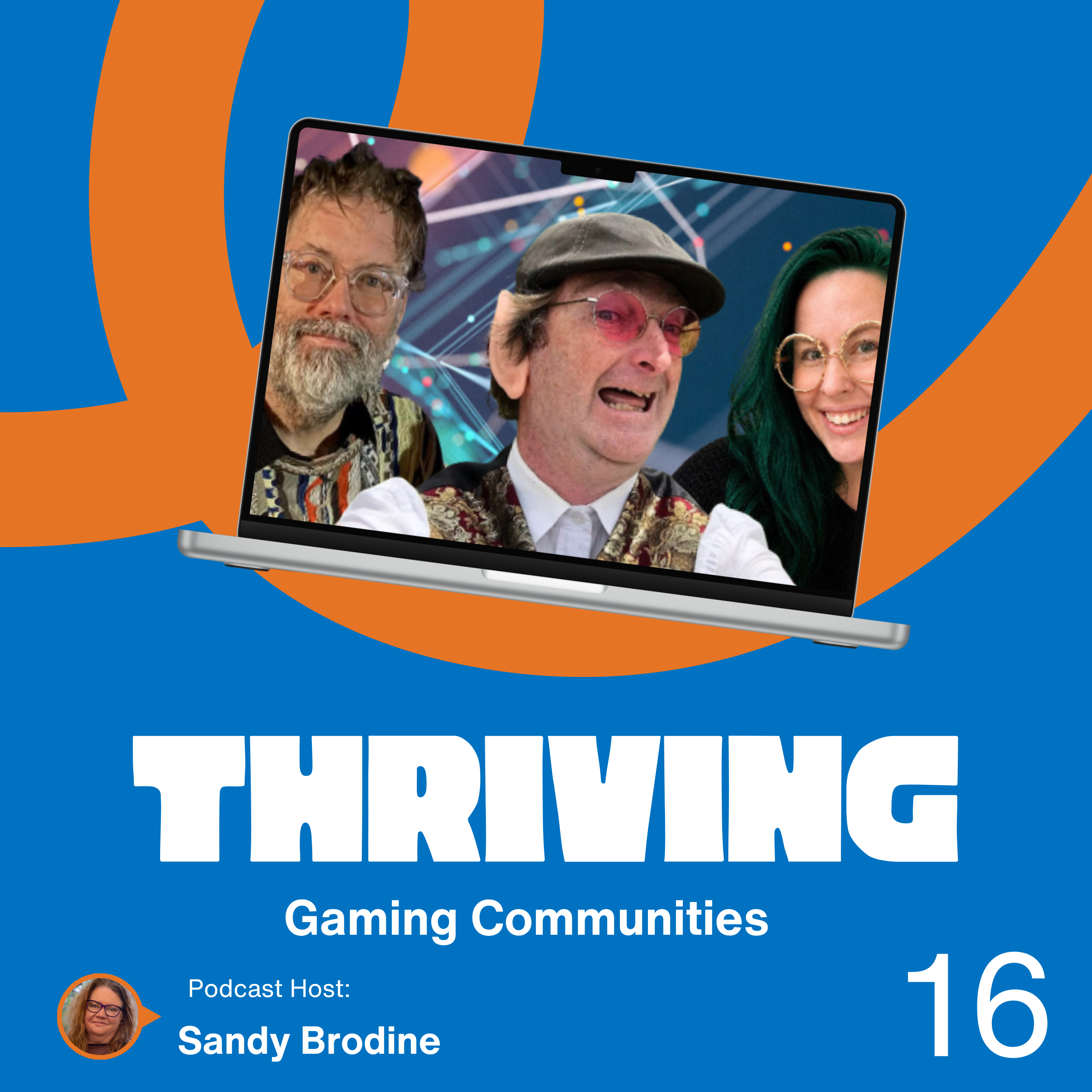
I have Will, Odd Rev, Will Nicholas. I have Kelly woods, my colleague and chief troublemaker from the Younger Generations team. And I have Lindsay Cullen, about to be congregational minister in a suburb I can't remember the name of near Sydney. Edgardine Engadine. I knew it started with E. Yep, Engadine. So welcome you three. We are going to speak about gaming culture, Thriving gaming communities. What on earth is a gaming Christian community? Why on earth would we want to have one? Why on earth should the church get involved? Can I just get you to spend 20 seconds introducing yourself and maybe a sentence about why you're passionate about gaming and then we'll leap into the conversation. Will, you can go first.
[00:01:30] Speaker B: Well, I'm Will, also known as Odd Rev, and I play board games for fun, but also recognize that board games are a community in a box. The rules, social contract and the opportunity to develop community come straight out of the box. As the old advertisement used to say, Parker Brothers kind of fun brings people together.
There is, there is a sense in which that normally I would put a background behind me, but today I've actually just let my wall speak for itself.
I have over 140 plus games at last count, although I think the number went up by about 8 at PAX over the last weekend. Yeah, so I am absolutely sold on the idea that creating fictional spaces where people can learn and play and grow and make mistakes together is an absolutely amazing way to develop community.
[00:02:19] Speaker A: Brilliant. I need to hear more. Kelly woods, you almost need our introduction, but who are you and why have I invited you onto this podcast?
[00:02:26] Speaker C: Kelly woods, if you've listened to Thriving, you would have heard myself alongside Odd Rev ones before. But other than that I'm also Pastoral Hair is how I go by in the digital world. I am a chief troublemaker in our office apparently, which I will take that badge with honor. And I grew up as a gamer with my family. I grew up as one of four kids. So the the ready board games that were available, that was six player for my family were Risk and Billionaire. And we did avoid Monopoly at all costs, which I know Odd Rev will be happy about. So Risk was pretty much how I grew up. Every Friday night our family play game of Risk, which then led me to be a gamer, whether it was digital through the tabletop, hanging out myself, my own regulation through to community spaces. So I'm all for it when it comes to spirituality and formation.
[00:03:17] Speaker A: Brilliant. And Lindsay Cullen, how does a former Assembly Associate General Secretary get invited onto a podcast like this with these two?
[00:03:25] Speaker D: Gosh, go.
I don't really know, Sandy. I love the idea that I'm a troublemaker. That's fantastic. I like being amongst the ranks of the troublemakers and I have a long association with different forms of pop culture. So I have a. Actually, we're just about to move and I've got a library of somewhere around 10,000 science fiction and fantasy books that we're trying to cull and get rid of before we move. So that's a real pain. I like, will have hundreds of board games and play various online games including. I really enjoy role playing games and so a lot of Dungeons and Dragons and Dagger Heart and Paranoia and stuff like that. And I think for me, you know, when you ask the question why should we be involved? My immediate answer is because it's fun. Like I when I went along to pax, I did not at all go with a sense of, oh, this is ministry and you know, I'm going to be looking for the ways in which I can ecclesiologically engage with community building. I went because I thought it would be fun to hang out with people that I like who enjoy the same sorts of things as me and to see lots of different online and tabletop games.
[00:04:42] Speaker A: So this is a very serious podcast and we're here to talk about thriving communities. See, the sad thing is, Will that most people will listen to it and they won't see what you just did, which was to pull your very serious face. This is a serious podcast and we're here to talk about thriving communities. And you three have all just talked about fun. So explain to me, what is pax? Why were you there and really were you creating community?
[00:05:07] Speaker B: Can I jump in straight away and say that the paradigm that we set up sometimes between seriousness and play is actually a completely false dynamic and sometimes as human beings, we are more serious about our play than anything else? Yeah, I don't know. You only have to go down to one of our many AFL grounds here in Victoria or one of the NRL grounds up in New South Wales. And you will see some people being extraordinarily serious about their play. And I would, I would put it to you that the nerds and geeks and dorks who are actually pulling stuff out of their board game boxes are just as serious about their play. A writer by, by the name of Hutzinger wrote a book called Homo Ludens which is all about the art of play back in the 1940s, I think it was, and in that said that one of the most serious endeavors that human beings engage in is their play. So I struggle with the idea that often, and it's a common thought, but, but the, that that playfulness is not serious is an obvious paradigm, but a completely false one.
[00:06:07] Speaker A: So I often use the word play when I'm talking to people about trying new things out, having a go thing new. And I use that because I actually think it encourages people to try things and have a go without the fear that they might, you know, do the wrong thing. You know, when we're going to start something new and missional and important in the church, we like to hammer down every possibility and make sure we've had 7,500 meetings first so that we can get the whole thing going rather than just playing with it. And if we make a mistake, we might learn something.
[00:06:39] Speaker C: I was going to say the other thing which will go straight into why PAX is amazing is that along with play being able to discern or help us find things that might not work in a very organic way, there is something really liberating about play. So we look at spaces, particularly war torn countries or things like that, for children to grow, for adults to be able to imagine, to actually grow in hope. All these things that are very salvific images, things that Christ really tells us we are to bring as the church for people in freedom is actually the ability to play, to imagine, to wander, to be able to dance and be. And so when we get something like PAX, which is where we were over last weekend, 85,000 people went to the Melbourne Convention and Exhibition center across the weekend.
[00:07:29] Speaker A: 85,000.
[00:07:31] Speaker C: 85,000 people who were engaging very seriously in play.
I think it's a no brainer why the church should be there because they are living the very core essence of what liberation and salvation actually means.
Because it's play and freedom and gaming. And if the church can't be for that, then I think we've forgotten what our message actually is. And, and if we kind of get A bit angsty about that and don't necessarily like the idea, then we need to revisit what our gospel is actually talking about. So anyway, so that's why I think the church should go and what it is. But I don't know, Lindsay, it was your first time at PAX over the weekend.
[00:08:12] Speaker A: Why on earth did you come all the way down to Melbourne for this?
[00:08:14] Speaker D: Well, I came to Melbourne because they run it in Sydney yet.
But I mean, just. Just to step back a bit and give a slightly more serious answer. You know, one of the things that I've been in. Involved in for the breadth of my career is the whole area of missional endeavors, urging church, new forms of church, fresh expressions, whatever you want to call it. And one of the key ideas is the idea of incarnational mission, that we move from a paradigm of saying we want to pull people into our place, get them to come to us, and instead we look at the model of the Incarnation where Jesus walks among us. And. And so the. The part of the answer is we go where there are people, and so there are 80,000 people at PAC go to be with them. Now, I think the flip side of the coin is that another really key idea for me is that we actually are living out ourselves authentically. So rather than me going to pacs as a missionary, who's going to learn about that culture and then try and, you know, sort of speak to people, I go to PACs because that's who I am.
And so rather than the paradigm of sharing our faith, which is like faith is this thing out here that we hold and we hand over to others, I share myself as a person of faith. And if I share myself, then I share myself as a Star Trek fan, I share myself as a fantasy fan. I share myself as someone who loves tabletop games, who loves playing role playing games. And so I go to the place that is not only important to me, but it's where others are gathered around something important.
[00:10:02] Speaker B: And absolutely. I couldn't agree more, Lindsay. And one of the things that then happens also is in that space, I share myself as a follower of Christ, as a representative of the church, as an opportunity. And this space has not had good or positive experiences of followers of Christ and members of the church. In fact, many people in this space, LGBTQIA people, women, gamers, imaginative, creative, freaky people who like to do crazy, odd things, have actually found themselves at the short end of the church's judgmental stick. And so when they meet us and we're a breath of fresh Air. We're actually welcoming, we're friendly, we're there on their terms.
That changes everything. I think the other thing I wanted to throw in was that in, in the area of incarnation that Lindsay said before is that games themselves are actually incarnational.
They allow us to try on and walk in the feet of someone who isn't and may never be us. And so from the simplest imaginative games that children play where they become fairies and princesses and soldiers and whatever else that they do, they're trying on and identity and incarnating themselves. Over my shoulder here, and I've pointed correctly, this game here is a game called Secret Hitler, which actually allows us to actually understand what it means to be a fascist and gives us the greatest warning against fascism and how easily it can rise, all in a little board game. And there are no consequences for this incarnation. At the end of the day, we pack everything up, we put it back in the box and we've learned something about ourselves and our world.
And we actually haven't actually hurt, harmed, damaged or done anything to someone. So I think that incarnational nature of board games is an amazing asset that we should be using more.
I'm tired of the idea that godly play is something that children do. I think we want to have the opportunity for adult play. And I don't mean anything incorrect or subversive about that. Yeah.
[00:12:06] Speaker A: So I'm interested in this idea of being incarnational and yet at the same time inhabiting a world that's not real. Because it seems to me that once you start talking about inhabiting a different character or being something that's not actually you, that's not really incarnational. Can you say a bit more about how it is?
[00:12:27] Speaker D: Can I jump in and just say there was a really interesting debate that went on and as someone who was working in the assembly, I was a. A big part of that about communion. When we had Covid and there was this engagement with can we do communion online, can we do worship online, etc. One of the things that I came across in my research as I was putting together papers for the assembly standing committee to consider this was we have built into our scriptures the description of the body of Christ, which is absolutely a virtual body. We're not saying that we are all somehow Jesus body reincarnated from, you know, 2000 year ago Palestine. We're saying that somehow we can be something that is real and that is meaningful, but is virtual. And I think there are so many other examples. And I'm sure Kelly and Will are going to jump in and give some about how things can be virtual but are still very real.
[00:13:30] Speaker C: Yes.
[00:13:30] Speaker A: I'm wondering if we eat the body of Christ and we drink Christ's blood might be another example of that. Because it's not actually really transubstantiated. It doesn't actually become Jesus body, but yet we are remembered or put back together as God's Christ's body when we. When we share communion with one another. That might be another virtual example of that, I think. Lyn's.
[00:13:55] Speaker C: Yes.
[00:13:55] Speaker A: Yeah.
[00:13:56] Speaker C: The other thing I like to think. Think about as well, which actually. Audrev, you might be able to jump in a little bit as well, because the conversations around identity or formation around personality, all these things, we speak of them as if they're like, formed and then finished. And then if we move off that, then whatever we're doing is a detour or a mental illness or something wrong or trying on something, you're testing it. When realizing that our personalities and identities shift and form our entire life on our last day on Earth, we are changing who we are, which is profound to think about for someone who, if they've managed to live a whole Life and they're 98, they are still changing who they are on their last day on earth. That's fascinating to me, but particularly when it comes to our young adult space or adolescent era, when we're doing formation or spiritual development or, you know, social development, who you are as an individual, when it comes to gaming, they inform and shape and do all that building block in order to help. People say, this is me, but this is also not me. So when we come to games and you try on a character, it allows people to help grow and define who they are. And if that changes core parts of their personality in a good way, great. That's exactly what gaming is supposed to do, which is exactly what we talk about in spiritual formation. And so how. For me, my question is, how do we keep Christian spiritual formation in this? How do we harness ethical conundrums and justice and moral, you know, quandaries?
[00:15:39] Speaker B: When we study formation, especially if we look at somebody like Fowler who talks about the stages of faith and growth, and we recognize a really important stage in that, that we usually ascribe to adolescents is a stage called moratorium. That means basically all bets are off. You can be whoever you want to be for a little while, so you can try on different kinds of identity and work out what works for you. This is a really, really important part, psychologists have said, of. Of the adolescent psyche. But I actually think that it's an important part of us, of our journey and formation through, through life. All kinds of things happen to us and for us and around us that cause us to have to re examine who we are and work out how we want to be. And we need spaces of moratorium to be able to, to cancel the expectations that might be surrounding us, that hold us in our roles and where we are, to allow us to explore, not only to confirm what we do believe is, is actually worth believing, to challenge the parts of what we do believe that might actually need significantly changing and to work out how we might become an integrated identity. And so to me, board games do this. They, they absolutely do this. They, they create a space where those expectations can be, can be shed for a while and, and I'd even go further. I don't know if I'm being heretical here, but I actually think this is something that God does. I think the English incarnation of Christ is an opportunity for God to actually step outside of their, their whatever space and actually experience something from the human perspective. I wonder whether or not the incarnation of Christ was an opportunity for God's growth and expansion in encountering something that they created that was entirely different to them.
[00:17:26] Speaker D: And if I could just add to what's been said that, you know, we've, we've already referred a few times to the idea of trying out and playing around with moral issues and questions. And I think that that's one of the most important things that we can do with gaming of different kinds. And you know, Will and I attended a event at PAX which was a live play of a role playing game, but with this twist that they had a random thing that people used each time before for a scene to decide whether they were going to be their good self or their evil self.
And so just to try on, you know, how do I play the same character but trying to be evil? How do I play the same character trying to be good? And you know, with video games you do much the same, you know. And I play a particular video game called Baldur's Gate 3 where one of the fun things to do is to say what happens if I don't play the hero, if I don't rescue the refugees, but I am complicit in their slaughter? How do I feel what happens in the game?
What are the consequences? What's the knock on effect of my relationships with other characters in the games because of how I've acted? And it's really very interesting to try these things out and actually to maybe say actually that was a line too far. Even in playing.
I don't want to do that again. That that made me feel really bad or whatever.
[00:18:57] Speaker A: I'm wondering about things like supervision or kind of where do you actually have the opportunity to then reflect back on what you've just said. So if I'm going to play a game and decide I want to try out being the bad guy, where do I get to do the work that about thinking about how that might affect me? IRL perhaps or you know, when I'm living my actual life.
[00:19:18] Speaker C: I was going to say with your friends who are gamers. And I think that's why it's so important that as Christians do hang out in. Well, for me I'd say as Christians because for me it's really faith dependent. But I know other people would do spiritual formation beyond that as well. But I think this comes down to hanging out with people and asking those ponderings. Like I know that we all play in a role playing game together, us three, but I think my favorite thing about that was Lindsay in the other campaign we used to do with a few of our wider uniting church. Oh beyond that just churched friends was, you know, you start with a session zero which is outlining things that you would like to achieve in the game and things that you wouldn't. So we get to speculate before we even begin and then we play and then at the end of the game before we all. Because we did this online, before we all log off or before we leave the table, we go how was that session? And we actually then talk about how we played it. And I think people think have this mental space that gaming is a solo thing. Gaming very rarely is. Solo gaming is predominantly and mostly done with other people. And particularly when it's done in communities such as our RPGs. They are based on the whole community working and storytelling together. So you actually do need to then like, you know, have a moment to then reflect together as a group. So that's just one example. I don't know if you two.
[00:20:42] Speaker B: Yeah, I, I would I guess really be wanting to be honest in relation to gaming just like anything else in that there are dark sides to every tool that we can pick up, everything that we can use. And that solo insular gaming can actually lead to behavior that might be destructive and it can be deformation and we all have the image in our mind of the, the, the, the nerdy guy with poor hygiene in his mother's basement, you know, who's, who's A keyboard warrior and, and not connecting with anyone. And, and I'll be honest, I've encountered lots of people who, who in the isolation of solo gaming have actually formed really, really negative and dark opinions. Which is why I spend my time trying to work out how we might be able to draw people together.
It's why I'm more in favor of tabletop gaming. It's why I love live streaming. These are all the aspects of this hobby, this culture that actually bring people together and give people the opportunity to be able to debrief with each other, to be peer supervised. And then the step beyond that is something that I think all three of us have been involved in is when we actually intentionally run what's called a simulation, use a game as a simulation with a briefing beforehand and a debriefing afterwards. I've got several on my bookshelf from the 1970s that are simulation games that are designed to get people to playfully encounter an experience and then unpack it to together afterwards. And so that's, that's not a new thing. I would also suggest that Hutzinger, in his book about Homo ludens actually talks about liturgy as play. Yes, we have a set of rules, we run through a process, we agree on a social contract and we, we create something together for a moment with a benediction, with a, with a beginning and a benediction that actually is, is playful, that parables are play, that they're a playful way to unpack and explore an idea. So, so there, there are these play elements in, in many of the things that we do already in our, in our Christian, but we're actually a little serious about them, like we said before, and we don't think that, that they're any laughing matter.
[00:22:49] Speaker D: And I think one of the things that I've come to appreciate is that there is a whole online culture that is directly engaged with these questions of meaning and trying to work out what, you know, things mean for people. So, you know, when you go on to some of the YouTube channels where people are doing playthroughs of these games, there'll be all these hundreds of comments where people are actually saying, you know, this is what it's like to play the evil person, or this is what I experienced, or, you know, the consequences of this actually lead to this other thing. So people are already doing that peer mentoring, whether they're doing them in real time groups or whether they're doing it in, you know, chat spaces and so forth as they engage with different forms of media, the same sort of Thing around movies, of course people talk about what's going on in this media. What do we think about the choices the characters are making?
[00:23:51] Speaker C: Absolutely. And I also think it's a thing that we can grow for our self reflection and do some spiritual disciplines within. Like, like I think of a game that I play called City Skyscape or Sky. Yeah, City Skyscape.
Either way, what I have to do is I've got to build a city from scratch and I put in all the roads and the population grows and then you have issues where the plumbing runs out, like you know, one area or you haven't put a Morgan. And so what happens when people pass away? So you are building this whole city, but you have the choice whether you start it, like how, where does your energy source come from? So are you building your city close to the wind tunnels? Are you building your city close to the edge? And it's really interesting because like I've restarted my city so many times because I was like, no, I'm going to try and do this in the most ethical way I can think about. So what happens if I only build this city only using wind turbines? And it's so interesting because I can build it that way. Or what if I only build this city using this? Or what's the tip over? When does the environmental impact shift? So can I start my city in growth in one way and then swap halfway through? All of those things are doing such, like I'm doing eco theology there, like what is my impact beyond myself with the environment?
How are we building and growing?
And I'm literally doing it ironically at a computer, like. But it, it really then challenges me then. So then when I go driving, I often do the drive from Victoria up through New South Wales and I always pass the wind turbines on the way. I'm brought back right to me at the computer thinking about the time when I had to build these wind turbines and it's given me a completely different relationship with that. But that's all from personal discernment. So how do we help grow these things within our people to be able to help themself walk through these spiritual discernment things so they can critique themselves.
[00:25:43] Speaker A: So just before we come to an end, I've got two questions I want to ask. So going back to a comment that Will made, how might we draw people together?
I wonder how we form community around gaming. Will, might you like to start with that one?
[00:25:58] Speaker B: Yeah, absolutely. So one of the things, things I was just looking for was just to have a look at my like in. If we're talking in a digital sense, then live streaming creates a massive amount of community. And so when I'm actually live streaming on Twitch tv forward slash odd rev, you can find me there. And I'm. I'll find that there'll be people jumping on from all over the world at all kinds of times of the day and they'll sit there and they'll talk, they'll chat, they'll give me hints, tips about how to play the game. And because time and space is transcended in that space, I might be sitting here at 2 o' clock in the afternoon playing a game while somebody at 3am somewhere else is watching. And they may be in desperate need of pastoral care or prayer or just someone to talk to. And so there's a sense that body doubling is something that happens in that space.
But more than that, at the tabletop we actually like. I went to one session that was actually run by the people at Coburg Uniting Church at Pax and they were talking about their board games group there and they were talking about the ways in which individual people who are lonely and have no idea how to actually join a community will actually contact them and turn up and start playing a game with them.
And we've had the same experience with our board game groups at Geelong in our community neighborhood houses that, that people might be at home trying to think to themselves how do I even begin to connect into a community? And I have no idea how to do that. A board gaming group is a safe way to do that because they don't actually have to bring small talk, they don't have to worry about who they'll meet when they get there. They don't have to worry about rules or social convention because all of that comes out of the box. All of that is given to us. When we sit down at a table with a cardboard box with meeples and dice and cards in them, we actually have a set of rules that actually mean that we can contract to be together socially. And that's, that's actually. That doesn't really occur anywhere else that I've experienced.
[00:27:59] Speaker A: You've helpfully led me into my Go on, Lindsay.
[00:28:03] Speaker D: I was just going to say, I think the other thing that I'd want to add to what Will said is that another part of the new paradigm of thinking missionally is the idea that we don't always bring everything good, but actually that we go looking for where good things are happening anyway, where God is already at work, where goodness is already at work. So I didn't have to go to PAX and bring community.
I went to PAX to experience a community that was already there. And while it's wonderful if you want to start a board gaming group as well, something like that as a community building project, the other thing that Will himself has done is just going along to a game store that already runs gaming and join the community that's already there and add to that community and bring yourself and your faith to that community. So I think that's a really important aspect is that it's not just about us using these tools to create something new. It's about going and seeing where there is already community and engaging in that
[00:29:06] Speaker A: space, which is a really strong fresh expressions component I'm thinking about as you're saying that. So just to finish off, I want to go back to A number of times I've heard things come out of our mouths that sound like the sorts of things that neurospicy, neurodivergent people will say about who they are. Kelly talked about I play my game to help me with my regulation.
Will talked about I don't need to have understand all the cues of what's going on when I turn up because the cues come out of the box. I wonder how gaming can be an effective way of growing community for people who are neurodivergent that find our probably very neurotypical ways of doing church less helpful. Will's jumping Go Will.
[00:29:51] Speaker B: Sandy One thing I have noticed is that neurotypical people aren't very good at playing board games. That often, often when a neurotypical person enters into a board game space, they might actually be going, okay, I need to understand what's going on here and I don't have control over all of the parts and I might make a mistake or I might say something silly or whatever. There's a sense in which that when we have a good sense of the social norms of how things work, when we're being requested to enter into a fantasy realm where things are all created, that actually in some ways I think levels the playing field a little bit, which is actually a bit of, a bit of a relief for neurodiverse people to actually suddenly. You know, I have watched an autistic 12 year old educate adults around a board game and I have, I have seen a person who might be largely non verbal in most other circumstances suddenly come alive and be able to tell every person exactly how every part of this world that they've actually been able to to invite other people into works and, and that is a treasure to behold. It is absolutely worth it, I would say, to people who are listening, who maybe haven't felt comfortable at board games. Maybe this is an opportunity to push yourself out of your comfort zone and, and, and, and give yourself an incarnational opportunity to, to explore what it might feel like to be neurodiverse so that you can be in a stronger position to pastorally care for people who are actually seeing the world in a very different way.
[00:31:22] Speaker A: Lin's final word from you.
[00:31:24] Speaker D: Look, I think for me this is such an opportunity to engage in just being who we are. And so often, I think, speaking for myself personally, you feel like the religious mold is, you know, you have to be a certain way and we were all joking about being serious and all that sort of stuff. Whereas actually I'm someone who, who enjoys reading comics, enjoys watching Star Trek, enjoys playing games. Isn't it a wonderful thing? If I can do that in community, can use it to explore all sorts of issues and can reach out and touch other people who have the same desires and hopes and dreams and things that they enjoy. It's fantastic.
[00:32:05] Speaker C: Yes.
[00:32:05] Speaker A: Well, that sounds like a good place to leave it. Thank you very much, Odd Rev Kelly and Linz for being with us today. And I hope to that we've exploded a few myths and encouraged some people to think differently about thriving gaming communities. See you next time.
[00:32:22] Speaker C: See ya.
[00:32:22] Speaker B: Bye.
[00:32:24] Speaker A: Thank you for listening to Thriving.
This podcast is hosted and produced by Sandy Brodine. If you have enjoyed Thriving, don't forget to like and subscribe. You might also like to share with your church community or friends and talk about how these ideas can help you grow your thriving community of faith. We'll see you next time.